
If your bathroom lighting project changes wiring, moves a switch, adds a fan, or touches the panel, you will usually need a permit in Maryland.
For most homeowners, the line is simple: a same-spot, same-box light swap is usually fine without a permit. Once the job includes new cable, a new box, a relocated switch, a fan/light combo, ductwork, or a new circuit, permit rules usually apply. Skip that step, and you could face failed inspections, extra labor, and added cost later.
Before you buy fixtures, check your project against this short list:
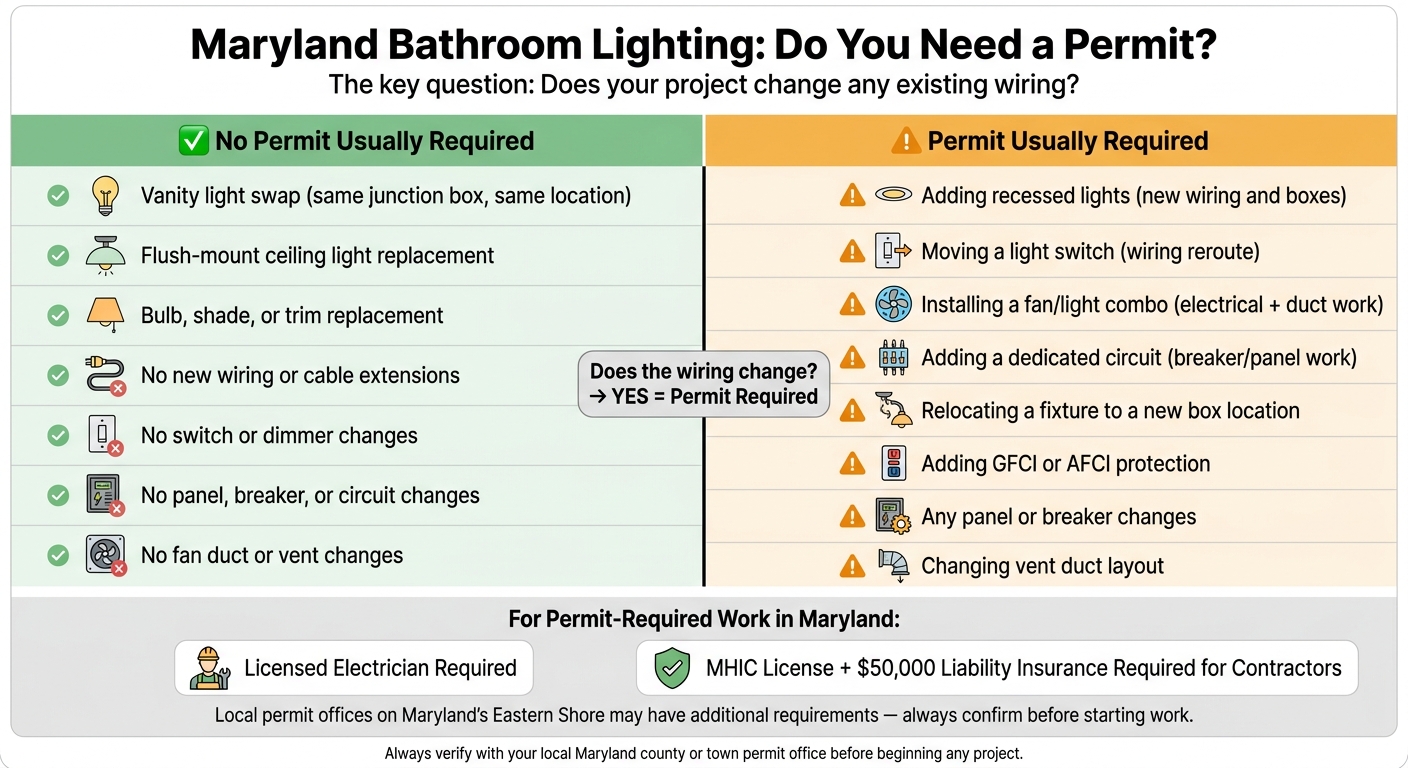
Maryland Bathroom Lighting: Permit Required vs. No Permit Needed
| Project | Permit Likely? | Why |
|---|---|---|
| Replace vanity light in same spot | Usually no | No wiring change |
| Add recessed lights | Usually yes | New wiring and boxes |
| Move a light switch | Usually yes | Wiring reroute |
| Install fan/light combo | Usually yes | Electrical + duct work |
| Add dedicated circuit | Usually yes | Breaker/panel work |
The short version: if the wiring stays the same, a permit often is not needed; if the wiring changes, it usually is. The details below explain where that line falls and what to confirm with your local Maryland permit office before work starts.
Permit-free bathroom lighting work is narrow. It usually means simple fixture replacement only on an existing junction box, in the same location, with no wiring changes.
Replacing a vanity light on the same junction box, in the same spot, is usually permit-free. The same goes for a flush-mount ceiling light, bulbs, shades, or trim.
Here’s the practical no-permit test. All of these need to stay true:
If even one of those changes affects the wiring, controls, or ventilation, you're no longer in simple swap territory. That’s when the work moves into permit-required work.
Use damp- or wet-location-rated fixtures in bathrooms.
If the work changes wiring, controls, or ventilation, you're usually in permit territory. A simple fixture swap is one thing. Once the job involves new cable, moved boxes, duct changes, or circuit work, Maryland usually treats it as permit-related.
The main triggers are new wiring, moved fixtures, ventilation changes, and circuit changes.
Adding recessed ceiling lights where none existed isn't just a style update. It means running new cable through walls or ceilings and installing new or moved electrical boxes. The same goes for moving a vanity light to a new box location or splitting the fan and light onto separate switches.
Those changes all involve one or both of these:
Relocating a switch also pushes the job into permit territory. Say you're moving it from one wall to another so the new layout works better. That still means extending or rerouting wiring, and that's the part that changes the job from cosmetic to electrical.
Installing an exhaust fan and light combo usually requires a permit, especially when the project adds new wiring, a new switch, or changes the vent duct layout. If there wasn't a fan there before, you're adding both electrical and ventilation work at the same time.
Changing the vent duct layout matters too. It's not just about where the fan goes. The duct path itself can make the job permit-related, and that can trigger both electrical and mechanical permits.
Panel and breaker work moves the project out of cosmetic-only territory fast. Adding a dedicated circuit, GFCI protection, AFCI protection, or making panel changes usually requires a permit.
Treat these as code-driven electrical upgrades, not simple finish work.
Once a bathroom lighting job goes past a simple fixture swap, the local permit office starts calling the shots. Maryland code applies across the state, but permits are issued by local offices, so the process can change from one county or town on the Eastern Shore to the next. At that point, this stops being just a state code question and turns into a local process issue.
Call the local permitting office before any work starts. Ask whether your project counts as routine maintenance or whether it needs a permit. If you're adding an exhaust fan and light combo, check whether separate electrical and mechanical permits are required.
You should also confirm:
If the office tells you the work is permit-required, bring in a licensed electrician before ordering materials.
For permit-required work, hire licensed pros early. That keeps the permit, wiring, and inspection steps in sync. A licensed electrician can deal with the code details that decide whether the job passes inspection.
Maryland home improvement contractors must hold a current MHIC license and carry at least $50,000 in liability insurance.
Start with one simple question: does the project change any existing wiring?
If the answer is no, you can often move forward without a permit. If the answer is yes, you're usually in permit-required territory. That's the line most homeowners need to watch.
Here’s a quick way to sort common bathroom lighting jobs.
| Bathroom Lighting Task | Permit Status | Typical Trade |
|---|---|---|
| Swapping a vanity light | Usually no permit (like-for-like replacement) | Homeowner |
| Adding recessed lights | Permit required (new wiring or wiring changes) | Licensed electrician |
| Installing a new exhaust fan/light combo | Permit required (new wiring and ventilation) | Licensed electrician/contractor |
| Relocating a light switch | Permit required (new wiring or wiring changes) | Licensed electrician |
| Adding a dedicated circuit | Permit required (new circuit or panel work) | Licensed electrician |
A like-for-like vanity light swap on existing wiring is usually permit-free. Once you add wiring, move a switch, add ventilation, or touch the circuit, a permit is usually required.
For Eastern Shore projects, check with the local permit office before you buy fixtures. OC Home Services confirms this permit line for homeowners on every bathroom remodeling job before fixtures get ordered. It's a small step that can save time, money, and a trip back to the store.
Yes. Contractors in Maryland have to meet state licensing rules, but that’s only part of the picture. Cities and counties often set their own building code rules, permit steps, and inspection standards for electrical work.
That local layer matters. A bathroom lighting job that’s fine in one area may need a different permit or inspection in another.
Before you start, check with your local permitting office or talk to a licensed electrician who knows your county or municipality.
It depends on where you live in Maryland. Permit rules can change from one county or town to the next.
Your best move is to call your local permitting office and ask if a homeowner can pull a permit for their own electrical upgrade. They can tell you exactly what applies to your project, your address, and the type of work you want done.
Skipping a required permit can come back to bite you. Unpermitted bathroom lighting work often shows up during a future home inspection, and that can stall a sale or throw the whole deal off track.
There’s also the bigger issue: safety and code compliance. If the work leads to property damage or other financial loss, you may not be able to recover anything through the Maryland Home Improvement Commission’s Guaranty Fund.
