
The short answer: hire the bathroom remodeler who is easiest to verify.
Before you look at tile, colors, or the lowest bid, check four things: an active MHIC license, at least $500,000 in general liability insurance, workers' compensation coverage, and direct bathroom remodeling experience. If plumbing, waterproofing, ventilation, permits, and hidden damage are not handled the right way, a cheap job can turn into water damage, delays, and extra cost.
Here’s the fast checklist:
Maryland homeowners also get added protection from the Home Improvement Guaranty Fund, which can reimburse up to $30,000 in some cases tied to licensed contractors. Homes built before 1978 may also need EPA lead-safe rules during demolition. On the Eastern Shore, timing matters too, especially for rental or seasonal homes that need to be ready before summer.
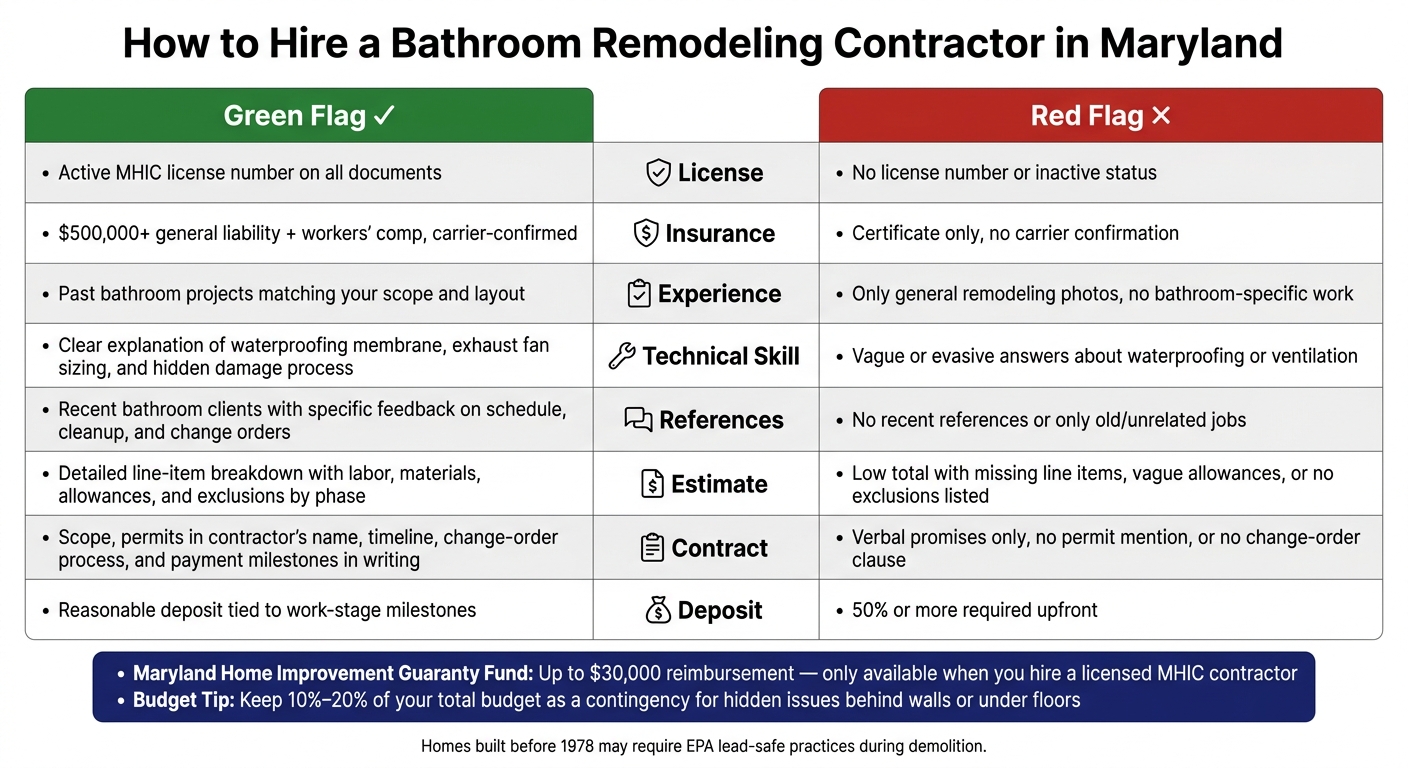
How to Hire a Bathroom Remodeling Contractor in Maryland: Green Flags vs. Red Flags
| What to check | What you want to see | Red flag |
|---|---|---|
| License | Active MHIC license | No license number or inactive status |
| Insurance | $500,000+ liability and workers' comp | Certificate only, no carrier confirmation |
| Experience | Past bathroom projects like yours | Only general remodeling photos |
| Technical skill | Clear answers on waterproofing and ventilation | Vague explanations |
| References | Recent bathroom clients with clear feedback | No recent references |
| Estimate | Detailed scope, allowances, exclusions | Low total with missing line items |
| Contract | Permits, timeline, change orders, payment terms | Verbal promises only |
| Deposit | Reasonable schedule tied to work stages | 50% or more up front |
The rest of the article breaks down how to check each item before you sign anything.
Start with the basics: check for an active MHIC license.
That one step does more than confirm the contractor can work in Maryland. It also helps protect your access to the Maryland Home Improvement Guaranty Fund, which can reimburse up to $30,000 for losses tied to incomplete or unworkmanlike work. If you pay an unlicensed contractor, you can't recover that money from the Fund.
A licensed contractor should put their MHIC number on estimates, proposals, and business materials. If it's missing, take that seriously. It's a red flag.
You can verify the license through the Maryland Department of Labor's occupational license search at labor.maryland.gov. Check two things right away:
That search also shows complaints and disciplinary actions. One old issue may not tell you much. A pattern of unresolved complaints is a different story. At that point, it's smart to move on.
Once the license looks clean, check insurance before you spend time judging experience.
Ask for a current certificate of insurance showing both general liability and workers' compensation coverage. As of June 1, 2024, Maryland contractors must carry at least $500,000 in general liability insurance.
Here's the plain-English version:
Then make one more call. Contact the insurance carrier directly and confirm the policy is active. A certificate by itself isn't enough. After that, you can move on to bathroom-specific experience.
After you verify licensing and insurance, cut the list down to contractors who do bathroom work in particular.
A contractor may handle kitchens, basements, and full-home updates, and still not be the right fit for a bathroom gut remodel. Bathrooms are their own animal. Shower waterproofing, plumbing, and ventilation all have to be done right. General remodeling work doesn't always cover that depth. And when a bathroom job goes wrong, the damage often stays out of sight until it spreads behind the walls or under the floor.
Ask to see projects that match what you're planning, not just a broad photo gallery.
If you want a tub-to-shower conversion, aging-in-place features like grab bars or a walk-in tub, or a layout change that means moving plumbing, ask for those exact kinds of jobs. Try to find past work that lines up with your scope, layout, and plumbing changes.
Older homes add another layer. Tight layouts, aging plumbing, and uneven framing can turn a simple plan into a messy one fast. A contractor who's dealt with those conditions before is less likely to get thrown off when the walls open up.
A bathroom contractor with hands-on experience should be able to explain their shower wall system in plain English. Ask what membrane or material they use and why they use it in Maryland's climate. In humid or coastal homes, waterproofing and ventilation matter just as much as the tile you pick.
Ask direct questions about:
Clear, specific answers usually mean they've been through these situations before. Vague answers are a red flag on bathroom jobs.
Hidden water damage, old wiring that doesn't meet code, and subfloor problems often don't show up until the old vanity and tile come out. A qualified contractor should already have a set process for documenting those findings and pricing them before work moves forward.
Once they can explain the technical side clearly, the next step is checking references and project photos.
Once you've checked technical skill, look at what happened after the contract was signed. That's where references and project photos help. They show whether the contractor followed through, kept standards steady, and delivered the same level of work from start to finish.
Ask for recent references from bathroom remodels, ideally in Maryland or in homes like yours. Older jobs can still be useful, but recent ones tell you more about the crew, supervision, and day-to-day process the contractor is using now.
When you call, skip the vague “were you happy with the results?” line. It doesn't tell you much.
Ask things like:
Those details matter. A bathroom remodel can look good in the final photo and still be a headache the whole way through.
Project photos can tell you a lot, but only if you look past the polished finish shot. Zoom in on grout lines, tile edges, trim cuts, and transitions. That's where sloppy work tends to show up.
Before-and-after sets are more useful when possible. They show how the contractor handled actual site conditions, like plumbing changes or structural issues behind the walls. For Maryland homeowners, photos from older homes or condos in similar neighborhoods are especially helpful. Pay close attention to layouts like yours, tile work, and waterproofing details.
Skip portfolios that show only final photos and no process shots.
Use what you find here when you compare written estimates and contract terms.
If the references check out, the paperwork needs to back up what you were told. Don’t judge a bid by price alone. That’s how homeowners miss gaps in scope, get hit with weak allowances, and end up staring at change orders they never saw coming.
The estimate should break out labor and materials by phase. It should also spell out what’s included, excluded, assumed, owner-supplied, and still unknown. At a bare minimum, the proposal should call out demolition, framing, plumbing, electrical, finishes, site protection, cleanup, and closeout.
Allowances deserve a close look. These are placeholder budgets for items like tile, vanities, or fixtures. If the allowance is too low for the finish level you want, you pay the gap later.
Exclusions matter just as much. If a bid says nothing about debris disposal, protection for nearby rooms, or project management labor, there’s a good chance those costs haven’t vanished - they’ve just been pushed down the road as extras.
A few warning signs should slow you down:
MHIC says homeowners should get at least three written bids before hiring a contractor and should not just take the lowest one.
It’s also smart to hold back 10% to 20% of your total budget as a contingency for hidden structural or plumbing issues behind the walls.
Once the estimate looks right, the contract becomes the rulebook for the job. It should lay out the scope, payment milestones, start and finish window, change-order approval process, warranties, and one named point of contact.
Most bathroom remodels need permits when plumbing, electrical, or structural work is part of the job. The contractor should pull those permits in their own name. If someone tells you to skip permits, that’s not a shortcut. It’s a problem.
For seasonal homes, add one more item to the contract: regular photo updates and schedule tracking.
At this point, the best contractor should be simple to check on paper and straightforward to deal with in person. Go with the one whose license, insurance, references, estimate, and contract are the easiest to confirm.
The lowest bid can be a trap when it leaves out scope, materials, or labor.
A good contractor answers the key questions clearly, puts the work in writing, and does what they said they'd do without last-minute surprises. That's the real test. If a contractor is easy to verify at every stage, they're far more likely to stay accountable once the job starts. OC Home Services applies this same verification standard to every kitchen remodeling and bathroom project, since an easy-to-check contractor tends to be an easy one to work with.
Maryland's Guaranty Fund gives you one more reason to hire a licensed contractor and check every detail before you sign. A bathroom remodel done right helps protect your home's value, keeps the project legal, and lowers the odds of cost overruns and poor workmanship - by hiring a contractor who is qualified and accountable.
Use the Maryland Department of Labor’s official online license search. Enter the contractor’s name or license number and check that their MHIC license is active and in good standing.
For insurance, ask for a current certificate of general liability insurance. As of June 1, 2024, contractors must carry at least $500,000 in coverage. You should also verify workers’ compensation insurance.
This part is simple, but it matters. A contractor can sound polished on the phone and still lack the paperwork to do the job the right way. Don’t take someone’s word for it - check it yourself.
Permit rules change from one Maryland county or town to the next. Local building departments handle code compliance, so the same job can trigger different paperwork depending on where the home sits.
In most cases, permits are required for:
Your licensed bathroom contractor should pull those permits in their own name. That keeps legal accountability where it belongs and gives you a clear paper trail if questions come up later.
Review times usually fall between 2 and 6 weeks, based on the scope of the project and the local jurisdiction.
If hidden water damage or rot shows up, your contractor should document it on the spot. Photos matter. Notes matter. A licensed pro should inspect the damage and give you a clear written estimate for the repair work, which is usually handled through a change order.
This is exactly why a contingency fund matters. Plan to set aside 10% to 20% of your budget for issues that don't show up until demolition starts.
Water damage isn't just a surface problem. If the source isn't fixed, the same issue can come right back. Make sure your contractor has hands-on experience with water damage restoration so they address the cause, not just the damage you can see.
