
For Salisbury homeowners, the short answer: keep a tub if it's the only tub in the house; choose a walk-in shower for an adult-focused primary bath.
On the Eastern Shore, this decision runs deeper than style. It touches daily use, resale value, cleaning, moisture control, install time, and layout fit. Smaller bathrooms and persistent coastal humidity sharpen the tradeoff. A tub combo serves kids, pets, and single-bath homes. A walk-in shower fits aging-in-place needs, primary baths, and lower-maintenance routines.
The full picture in plain terms:
| Factor | Walk-In Shower | Tub-Shower Combo |
|---|---|---|
| Accessibility | Better for low-step entry | Harder to enter because of tub wall |
| Best users | Adults, aging-in-place households | Kids, pets, mixed-use households |
| Space feel | Often feels more open | Uses a standard alcove footprint |
| Cleaning | Less grout and fewer tight spots | More spots for soap scum and mildew |
| Moisture control | Needs precise slope and waterproofing | Tub basin keeps more water contained |
| Resale | Good in a primary bath | Safer if it’s the home’s only tub |
| Install work | More labor if custom tile and glass | Simpler if using a standard unit |
In homes with more than one full bath, a walk-in shower often makes sense in the primary. In a single-full-bath home, keeping the tub is the safer call for daily use and future resale. On the Eastern Shore, that tradeoff comes up often.
The sections below cover where each option works best, what drives cost, and what to confirm before work starts in Salisbury or Wicomico County.
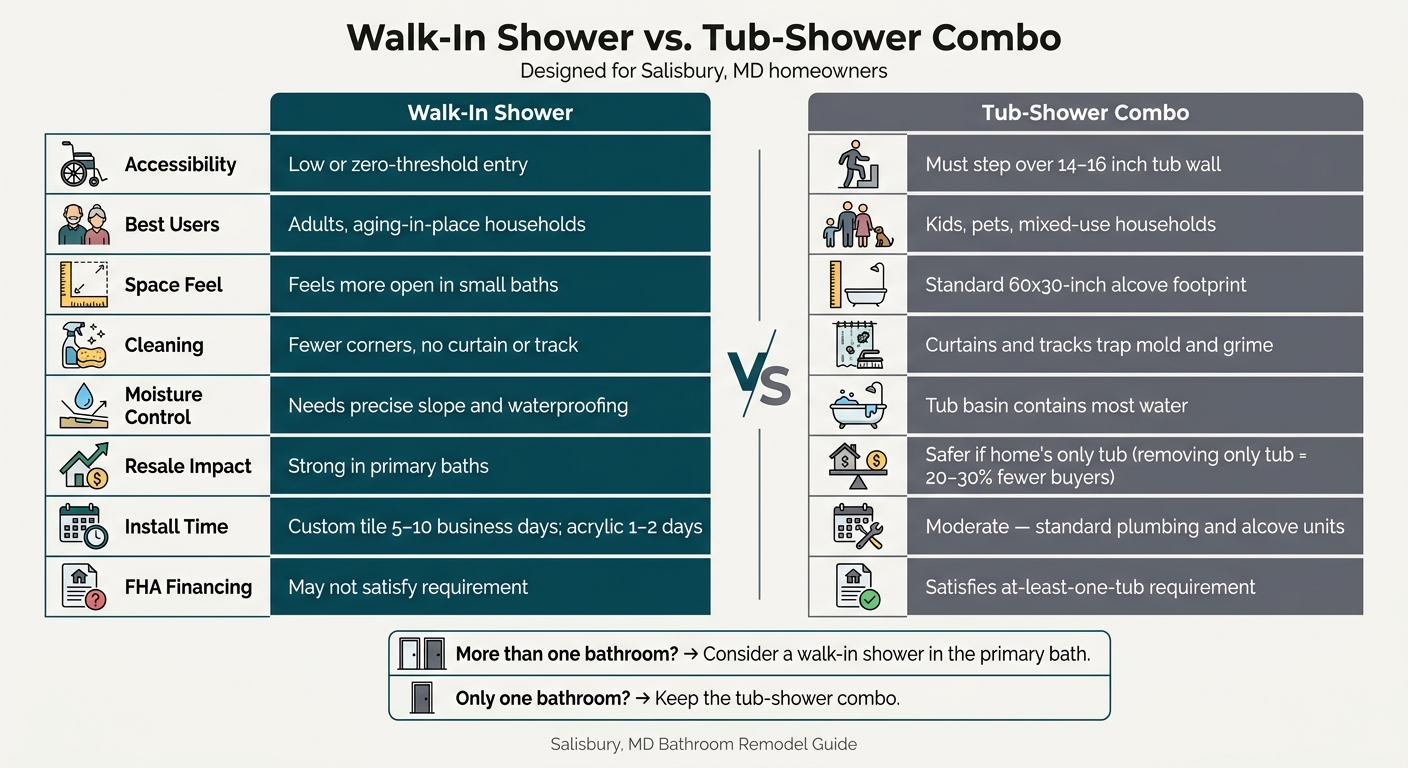
Walk-In Shower vs. Tub Combo: Salisbury MD Homeowner Comparison
Here’s the plain-English version for Salisbury homes. This side-by-side view helps narrow the choice before you get into how the bathroom is used day to day.
| Factor | Walk-In Shower | Tub-Shower Combo |
|---|---|---|
| Accessibility | Excellent - low or zero-threshold | Less accessible - requires stepping over a 14–16-inch tub wall |
| Family Use | Best for adults; difficult for young children or pets | Ideal for kids, pets, and soaking |
| Guest Use | Better for adult guests who do not need tub access | Flexible for all ages and needs |
| Space Efficiency | Feels less cramped in small bathrooms | Standard 60 x 30-inch alcove footprint |
| Maintenance | Easier to keep clean with fewer corners and no curtain | Curtains and tracks can trap mold and grime |
| Moisture Performance | Needs strong waterproofing and proper drain slope in humid coastal conditions | Tub basin contains most of the water |
| Resale Appeal | Strong in primary baths | Safest if it's the home's only tub |
| Installation Complexity | Higher - custom waterproofing, floor slope, and drainage | Moderate - standard plumbing and alcove units |
A walk-in shower usually fits best in a primary bathroom, especially if another bathroom in the house already has a tub. That setup gives you more freedom. You can build for comfort and access without giving up the one feature many families still want somewhere in the home.
Curbless showers also make a lot of sense for aging-in-place remodels. And in a smaller bathroom, a glass-enclosed walk-in shower can make the whole room feel more open than a big tub surround. It’s one of those changes that can shift how the space feels, not just how it looks.
The catch is the install. Walk-in showers ask for tighter execution. The drain slope has to be exact, the waterproofing has to be done right, and the tile work is often more involved than it is with a standard tub surround. If that waterproofing fails, moisture can get where you can’t see it. In coastal Maryland bathrooms, that’s the main risk.
A tub-shower combo is often the practical call for hall baths, one-bathroom homes, and homes with young children. For little kids, a tub is just easier. Same story for bathing pets or for anyone who wants the option to soak once in a while.
There’s also the resale side of it. Removing the only bathtub can shrink your buyer pool, since many buyers still want at least one tub. In a one-bath Salisbury home, a tub combo usually keeps your options open.
From there, the choice comes down to which bathroom you’re remodeling and who uses it most.
Looking at fixtures alone only tells part of the story. The bigger difference shows up in how each setup works in actual Salisbury bathrooms.
In a primary bath, a walk-in shower makes everyday use simpler. It also cuts down on cleaning, which matters more than most people expect once the remodel is done.
For aging-in-place projects, it makes sense to add blocking now for future grab bars and use slip-resistant porcelain with a DCOF of at least 0.42.
Long-term performance comes down to the basics done right: proper slope, solid waterproofing, and strong exhaust ventilation. Frameless glass doors can look sharp in Salisbury primary baths, but there’s a catch. They need precise tile installation so the glass sits flush.
A tub-shower combo still makes a lot of sense in hall baths and one-bath homes. If you’ve got kids, pets, or anyone who wants an actual soak, the combo earns its keep.
In vacation rentals, walk-in showers are faster to clean, but keeping one tub is still the safer resale move for family use. For this kind of bathroom, acrylic surrounds are worth a hard look. They install fast and are easier to maintain than tile.
Salisbury humidity is hard on bathrooms. Grout, caulk, and paint can wear down fast if ventilation isn’t doing its job.
Your exhaust fan should match the room’s square footage and vent straight to the exterior. For tile, larger-format porcelain helps by cutting down the number of grout lines, which can limit moisture penetration over time. In wet areas of a coastal Maryland home, porcelain rated at 0.5% water absorption or less under ASTM C373 is the right pick.
"Higher humidity makes ventilation and material choice critical." - Kitchen Concepts Plus
Those room-by-room differences also shape cost, timeline, and permit planning.
Once you know how each option performs, the next step is simple: match the fixture to how the bathroom is used, what the remodel will cost, and how the change may affect resale.
| Bathroom Type | Best Fixture | Key Reason |
|---|---|---|
| Primary bath (adults only) | Walk-in shower | Best for adult use and easier upkeep |
| Hall bath or one-bath home | Tub-shower combo | Essential for families, pets, and broad resale appeal |
| Guest bath (multi-bath home) | Either, tub preferred | Preserves flexibility for mixed guest use |
| Vacation or rental property | Walk-in shower with one tub elsewhere | Faster turnover, while still keeping a tub for family renters |
If the home has only one full bath, keep the tub. That one choice matters more than many homeowners think. Removing the only bathtub can shrink your buyer pool by 20% to 30%. FHA financing also generally calls for at least one bathtub in the home.
Cost and timeline come down mostly to scope.
The biggest swing factor is plumbing relocation. If the new fixture stays in the same footprint as the old one, you avoid moving drain lines and supply valves. That cuts labor in a big way. In older Salisbury homes, subfloor condition can also change the job fast. Demo may expose moisture damage or rot, and that has to be fixed before a new pan or surround goes in.
Walk-in showers also need about 20% to 30% more tile than a standard tub surround. That affects both material cost and install time. A custom tile shower with frameless glass usually takes 5 to 7 business days, while an acrylic wall system can often be done in 1 to 2 days. For rental owners, that shorter turnaround with acrylic can make a lot of sense.
After budget and scope are set, permit rules are the next thing to check.
Any bathroom remodel in Salisbury that includes plumbing, electrical, or layout changes may need permits and inspections. Check with Wicomico County or the City of Salisbury before work starts. The rules depend on the scope of work and which jurisdiction applies.
Maryland law also says any contractor doing home improvement work must hold an active Maryland Home Improvement Commission (MHIC) license. Verify that before you sign a contract.
With the fixture choice, budget, and permit path sorted out, the final call comes down to how the bathroom will be used day to day.
After looking at daily use, resale, and moisture issues, the choice comes down to one thing: how the bathroom works in your home.
A walk-in shower makes more sense for adult-focused primary baths, aging-in-place plans, and easier cleaning. A tub-shower combo fits better for homes with children or pets, one-bath layouts, and buyers who want the most flexibility.
On Delmarva, moisture control isn't optional. Humidity affects both layouts. Whether you go with a shower or keep the tub, proper waterproofing and good ventilation matter — and both require installation that accounts for the coastal climate.
Bathroom count is the clearest tie-breaker. If you have more than one bathroom, turning the primary bath into a walk-in shower is often the better move. If your home has only one bathroom, keeping the tub helps protect resale and works for the broadest mix of users.
For homeowners planning a bathroom remodel on the Eastern Shore, OC Home Services handles this kind of layout decision as part of the planning process. Accessibility and moisture resistance are easier to build in from the start than to retrofit later.
Usually, yes. For the best mix of day-to-day comfort and resale value, most real estate pros suggest keeping at least one bathtub in the home.
Taking out every tub can cut your buyer pool by 20% to 30%. Families with young children often see a tub as non-negotiable. If you have more than one bathroom, the common move is simple: keep a tub in the hall or guest bath, and use walk-in showers in the other bathrooms.
In Salisbury, added value has less to do with one fixture “winning” and more to do with what your home already has.
If there’s already another bathtub in the house, a walk-in shower is often the better move for a primary bathroom. It fits how many owners use that space day to day, and it tends to play well with resale.
The bigger issue is what happens when you remove the only tub. If your home has just one full bathroom, taking out that bathtub can shrink your buyer pool by 20% to 30%. That’s a big hit for a change that may feel minor during the remodel.
For resale and for day-to-day family use, it’s smart to keep at least one tub-shower combo in a hall or guest bath.
Ask if your layout will require moving plumbing. Keeping the current drain and supply lines in place can help control costs, and that one detail often makes a bigger difference than people expect.
You should also ask about waterproofing, hot water heater capacity if you want a tub, and whether features like walk-in tubs or pump systems will need added electrical circuits.
Design choices matter too. Tile layout and pattern work can add labor, and glass enclosures can affect both the total budget and the timeline.
