
Open kitchens fit view-focused and guest-heavy Eastern Shore homes. Closed kitchens fit daily cooking, storage, and noise control. On the Eastern Shore, the right answer often lands somewhere between the two.
In older Salisbury homes, a kitchen remodel that touches layout isn't just a style decision. Wall removal can affect smells, sound, cabinet count, HVAC load, and permit cost. Many Delmarva homes land on a middle option — a partial wall opening or peninsula — rather than going fully open or fully closed.
Before changing the layout, these factors shape the decision:
| Factor | Open Kitchen | Closed Kitchen | Middle-Ground Option |
|---|---|---|---|
| Best for | Waterfront homes, vacation homes, hosting | Year-round homes, frequent cooking, smaller layouts | Older homes that need flow without full wall removal |
| Light and views | More light, longer views | Less light between rooms | Some added light without full exposure |
| Noise | Sound carries into living areas | Better sound separation | Some sound control stays in place |
| Cooking odors | Smells travel fast | Smells stay more contained | Better control than fully open |
| Storage | Less wall space for cabinets | More cabinet and pantry space | Keeps more storage than open |
| Clutter | Always visible | Easier to hide | Partly visible |
| HVAC load | Higher in many homes | Lower room by room | Often easier to control |
| Remodel cost risk | Higher if walls are structural | Lower if layout stays put | Often lower than full opening |
About 7 in 10 U.S. remodel jobs now lean toward more connected living spaces, but that does not mean every Eastern Shore house should lose its kitchen walls. A beach house used on summer weekends has different needs than a full-time family home used every day.
If your home needs better flow but you do not want to lose storage or deal with a full structural change, a partial opening is often the best place to start.
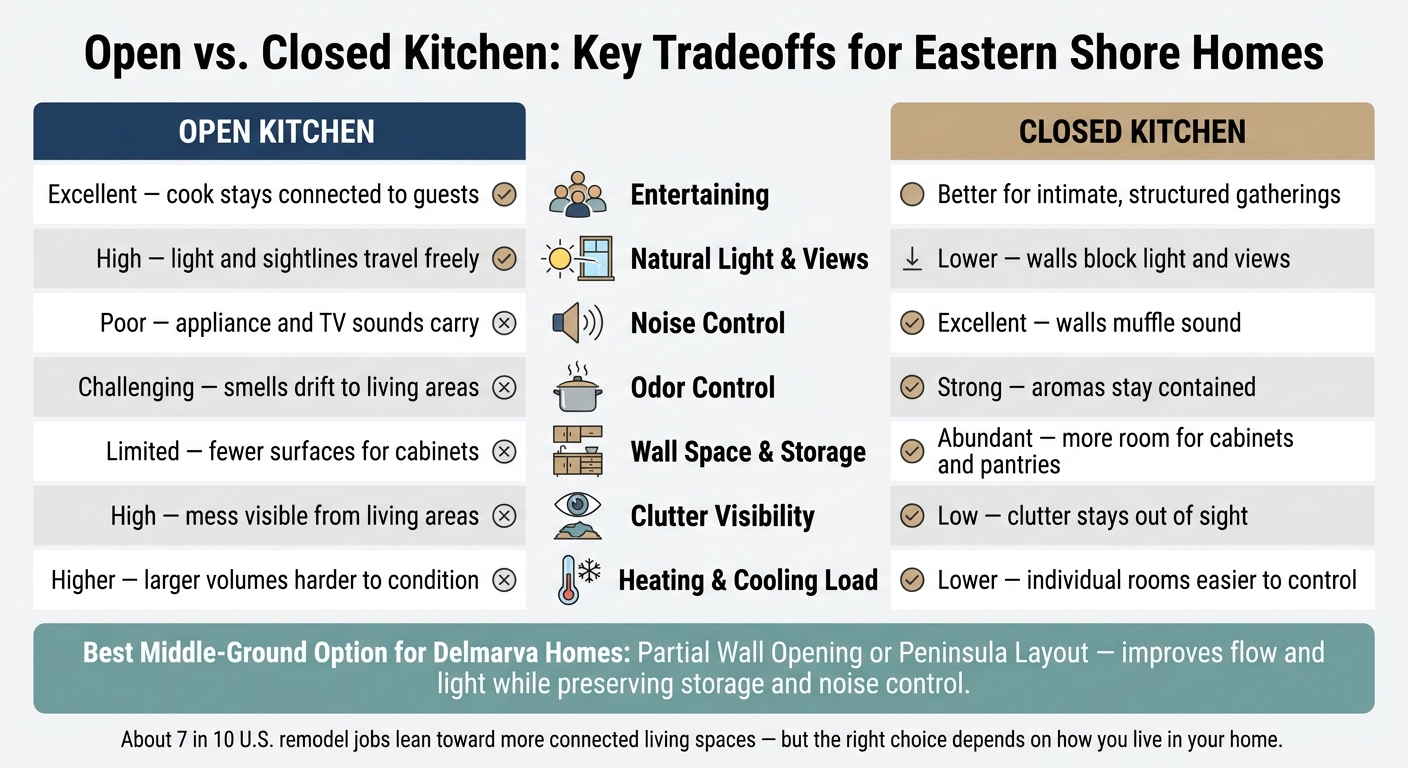
Open vs. Closed Kitchen: Key Tradeoffs for Eastern Shore Homes
For Eastern Shore homes, the better layout usually comes down to how you cook, host, store things, and live in the house through different seasons. That’s true whether you’re dealing with an older compartmentalized floor plan in Salisbury, a waterfront property, a beach rental, or a full-time family home.
The practical tradeoff for Delmarva homes is pretty simple: open kitchens improve connection and views, while closed kitchens protect storage, quiet, and odor control.
| Feature | Open Kitchen | Closed Kitchen |
|---|---|---|
| Entertaining | Excellent; lets the cook stay connected to guests | Better for more intimate, structured gatherings |
| Natural Light & Views | High; light and sightlines travel freely | Lower; walls block both |
| Noise Control | Poor; appliance and TV sounds carry | Excellent; walls help muffle sound |
| Odor Control | Challenging; smells drift to living areas | Strong; aromas stay contained |
| Wall Space & Storage | Limited; fewer surfaces for cabinets and pantries | Abundant; more room for cabinets, pantries, and furniture |
| Clutter Visibility | High; mess is visible from main living areas | Low; clutter stays out of sight |
| Heating/Cooling Load | Higher; larger volumes are harder to condition | Lower; individual rooms are easier to heat and cool |
This tradeoff tends to favor open layouts in vacation homes, waterfront properties, and houses where the kitchen doubles as the main gathering space.
Open kitchens work well in waterfront and vacation homes because they stretch views, pull in more light, and let the cook stay part of the conversation. In coastal homes, the kitchen often turns into the center of summer hosting, quick lunches, and morning coffee with a view. That matters more than people think. If the whole point of the house is to enjoy the setting, walls can get in the way.
For families with young kids, there’s another plus. An open layout lets a parent at the stove keep an eye on the living room without stepping away from the kitchen.
This tradeoff tends to favor closed layouts in older Salisbury-style floor plans and homes where cooking happens every day.
Closed kitchens have a clear edge for households that cook often and for year-round residents. Daily frying, searing, or simmering can become a quality-of-life problem when smells drift straight into the living room. Open layouts also cut down wall space for cabinets and shelves, which matters in smaller Eastern Shore homes.
A closed kitchen gives you more storage, better noise control, and a little breathing room from daily mess. Sometimes that separation just makes the house easier to live in.
The best layout has less to do with looks and more to do with daily life.
Older homes in Salisbury and nearby Eastern Shore towns often have smaller rooms with more separation. Those walls aren't always simple to remove. They often hide wiring, plumbing vents, or HVAC returns, and once that work starts, you may be looking at rerouting systems and added cost.
For full-time households, a partially open or closed kitchen usually makes more sense. You keep more storage, cut down on noise, and make it easier to control comfort from room to room. That matters when the kitchen gets used hard every day, not just on weekends.
That balance changes in homes built more around guests, views, and part-time use.
Vacation homes usually lean the other way. In these spaces, openness often wins because it keeps sightlines clear, connects the cook with guests, and makes the main living area feel bigger.
That setup works especially well in waterfront homes, where the view is part of the point. An open kitchen helps pull that view deeper into the house instead of boxing it off behind walls.
Open living does come with a catch: mess spreads fast. Durable, easy-to-clean finishes help, and a mudroom or entry zone for beach gear can save the rest of the house from sand, wet towels, and everyday clutter.
Middle-ground layouts often make more sense in Delmarva kitchens than a full open-concept remodel. If tearing everything open feels like too much, these options can bring in more light and improve movement without giving up storage or that bit of separation many homes still need.
A partial wall opening, wide cased opening, or pass-through can improve flow while still keeping some division between spaces. That matters when you want help with noise, cooking odors, and cabinet space.
An arched opening between the kitchen and living room can improve flow without full wall removal. It can also help you avoid costly rerouting and keep more usable wall space for cabinets.
This works well when you want a more open feel without giving up what a closed kitchen does well.
In narrower Delmarva kitchens - especially ranchers and older colonials - a peninsula often makes more sense than a full island. It adds seating and counter space without needing the clearances a freestanding island calls for. In plain terms, it lets the kitchen work harder without making traffic feel boxed in.
For larger waterfront or entertaining-focused homes, a separate prep kitchen can be a strong move. In February 2026, designer Jess Weeth of Weeth Home completed a 7,800-square-foot gut renovation in Henlopen Acres, Rehoboth Beach, that featured two adjoining cook spaces: a blue-and-white entertaining kitchen with an ocean-facing island and a separate secondary kitchen for prep and storage.
Here’s how the main in-between options compare:
| Option | Storage Effect | Structural Complexity | Best-Fit Home Type |
|---|---|---|---|
| Partial Wall / Cased Opening | Preserves some wall storage | Low to Moderate | Older Salisbury-style homes; colonials |
| Peninsula Layout | Adds storage and seating | Low | Narrower Delmarva kitchens; ranchers |
| Separate Prep Kitchen | Maximizes storage across two zones | Very High | Luxury waterfront estates; entertaining-heavy homes |
The right middle-ground layout has to work in coastal conditions, not just look good in a plan.
Open kitchens need stronger ventilation because odors, grease, and moisture travel farther. In coastal Delaware, moisture-resistant cabinets, easy-clean finishes, and balanced HVAC help prevent hot and cold spots and make the space easier to live with day to day.
Once you understand the layout tradeoffs, the next step is simple: find out whether that wall can come out safely and legally.
Opening up a kitchen is not just a demo job. In older Eastern Shore homes, walls often hide the parts of the house that matter most.
A wall may carry roof or floor loads. It may also conceal plumbing, wiring, or HVAC that has to be moved before anything comes down. That shows up a lot in older Salisbury-style homes, where chopped-up floor plans often mean interior walls are doing more than they seem to be doing. Once a wall comes out, you may also run into flooring gaps, ceiling patches, and finish mismatches that add both time and cost. And in older homes, demolition has a way of exposing issues no one could see at the start, so leaving room in the budget matters.
That structural review usually leads straight into permits, because removing a wall often sets off code-required work.
Permits are usually required for structural changes, beam installation, electrical work, plumbing moves, and HVAC changes in Maryland and Delaware. You should also expect inspections at the structural, rough-in, insulation, and final stages. Skip permits, and the problem does not always show up right away. It often shows up later, during an insurance claim or when you try to sell. Buyers and lenders are checking permit history more closely, and unpermitted structural work can delay a sale or stop it cold.
Maryland requires MHIC-licensed contractors for home improvement work, so check the license number before you sign anything. That helps protect safety, supports the inspection process, and keeps your home's permit record in good shape for resale.

This is where a design-build review can save a lot of guesswork before demolition starts. OC Home Services is an MHIC-licensed (#132817) Salisbury contractor that helps homeowners review layout options, project scope, and budget for kitchen remodels across the Eastern Shore.
The right kitchen layout comes down to how you use your home, how much storage you need, and how much structural work you are ready to take on. In many Delmarva homes, a partial opening or peninsula gives homeowners the best mix of flow, storage, and cost.
The safest move is to get a professional review from a structural engineer or an experienced contractor. A wall can hide structural parts, plumbing lines, electrical wiring, or HVAC returns, so a quick visual check usually isn't enough.
Before any demolition starts, have an expert confirm whether the wall is load-bearing and spell out what support is needed, if any. That could mean an LVL beam, columns, or both.
It depends on how much separation you want between the spaces - and how much you care about noise, storage, and sightlines.
A partial opening, like columns, a wide cased opening, an arch, or a partial wall, gives you a middle ground. You keep some division between rooms, but the space still feels open and light.
That setup often makes sense if you want more wall space for cabinets and storage. It can also help if you want the kitchen to feel a bit quieter and more separate from the living area, especially when heavy cooking is part of your day.
Open floor plans usually add more resale value on the Eastern Shore. Buyers tend to like them because they make a home feel bigger, brighter, and more connected from room to room.
That said, not everyone wants one big shared space with zero separation. Many buyers lean toward a middle ground. Semi-open designs - like partial walls, kitchen islands, or glass partitions - keep that open feel while still giving you some storage, privacy, and sound control.
