
If your kitchen remodel in Salisbury changes wiring, plumbing, gas, venting, or walls, you will likely need a permit. Painting, swapping flooring, adding backsplash tile, or replacing cabinets and counters in the same layout usually does not.
Cosmetic work is permit-free. System or layout changes are not.
County review is often listed at 10 to 14 business days. If a contractor pulls the permit, Salisbury requires proof of an active MHIC or Home Builders license. No work should start before the permit is issued.
Confirm the job scope first, then match each part of the work to the right permit type: building, electrical, plumbing, gas, or mechanical. That step helps avoid stop-work orders, failed inspections, and resale problems later.
Salisbury requires a permit for kitchen work that changes the structure or adds new construction. In plain terms, once a project goes beyond surface-level updates, permits usually come into play.
Here’s how that rule applies to common kitchen remodel tasks.
Moving a sink to another wall requires a plumbing permit. The same goes for adding a dishwasher line, a new water supply line, or new drain lines. If the work reaches under-slab sewer lines, permits and inspections are required, including an underground inspection before concrete is poured.
Electrical work follows the same pattern. Adding dedicated appliance circuits, relocating outlets, or running power to a new island requires an electrical permit. Maryland building code also requires GFCI protection on all kitchen countertop outlets.
A new gas line for a range requires a gas permit. An exterior-vented range hood needs a mechanical permit because it vents to the outside.
Removing a wall - load-bearing or not - requires a building permit in Salisbury. If the wall is load-bearing, the project also needs engineered drawings, especially when the work involves laminated beams, steel beams, or changes to floor or roof truss layouts.
Changing the footprint of the space can also trigger permit rules. Widening a doorway, changing a window size, or creating a new exterior opening from the kitchen requires a building permit. For this type of work, the city asks for two sets of scaled drawings with floor plans, header and girder sizes, and exterior elevations.
| Kitchen Task | Permit Required | Likely Permit |
|---|---|---|
| Sink replacement in the same location | No | N/A |
| Moving a sink to a new wall | Yes | Plumbing |
| Adding recessed lights (new wiring) | Yes | Electrical |
| Adding an island with a power outlet | Yes | Electrical |
| Installing a new gas range and line | Yes | Gas / Plumbing |
| Exterior-vented range hood | Yes | Mechanical |
| Removing a non-load-bearing wall | Yes | Building |
| Removing a load-bearing wall | Yes (engineering required) | Building |
| Enlarging or moving a window | Yes | Building |
This table is practical guidance, not a substitute for local approval. Confirm permit rules with the Salisbury Department of Infrastructure and Development before work begins.
Next, the key question is who pulls the permit and what inspections follow.
In Salisbury, permits usually are not needed for nonstructural repairs or cosmetic kitchen updates, as long as you are not changing electrical, plumbing, mechanical, or structural systems. That’s the whole line, plain and simple: cosmetic work is usually fine; system changes are not.
Replacing cabinets and countertops is usually permit-free if the layout stays the same and no plumbing or electrical lines are moved. The same goes for painting, installing backsplash tile, and replacing flooring.
That said, the moment a project moves a sink, outlet, or appliance location, it usually shifts into permit territory. A kitchen can look like a simple facelift on the surface, then turn into permit work fast once the layout starts changing.
Swapping a light fixture in the same location without changing wiring usually does not need a permit. Replacing a refrigerator, electric range, or dishwasher with a similar unit in the same spot also typically does not require one, as long as no new wiring, plumbing, or gas work is involved.
The catch is pretty straightforward. If the new appliance needs a larger circuit, a new circuit, a gas line change, or plumbing changes, a permit is usually required. Same spot does not always mean same scope.
Some kitchen jobs look simple but can still trigger code rules once walls, wiring, or pipes get involved. This table shows where common projects usually land and what tends to push them into permit-required work.
| Task | Usually No Permit | Why It May Become Permit-Required |
|---|---|---|
| Cabinets | Replacing or refacing cabinets in the same footprint | Relocating cabinets can require moving electrical outlets to meet current code spacing |
| Countertops | Installing new countertops on the existing footprint | Moving the sink or cooktop location requires plumbing or gas line changes |
| Flooring & Backsplash | Replacing flooring or installing a backsplash in the same location | Structural repairs, such as work on floor joists, may require a permit |
| Electrical | Swapping a light fixture or outlet cover using existing wiring | Adding recessed lighting, moving outlets, or upgrading the electrical panel |
| Plumbing | Replacing a faucet or a like-for-like sink or dishwasher in the same spot | Relocating the sink, dishwasher, or adding a new pot-filler line |
| Appliances | Swapping an electric range or dishwasher in the same location | Converting from electric to gas, or adding a new dedicated 240V circuit |
| Ventilation | Replacing an existing recirculating range hood | Installing a new hood that requires cutting a hole for exterior venting |
If the project crosses into system work, the next issue is who pulls the permit and what inspections come after.
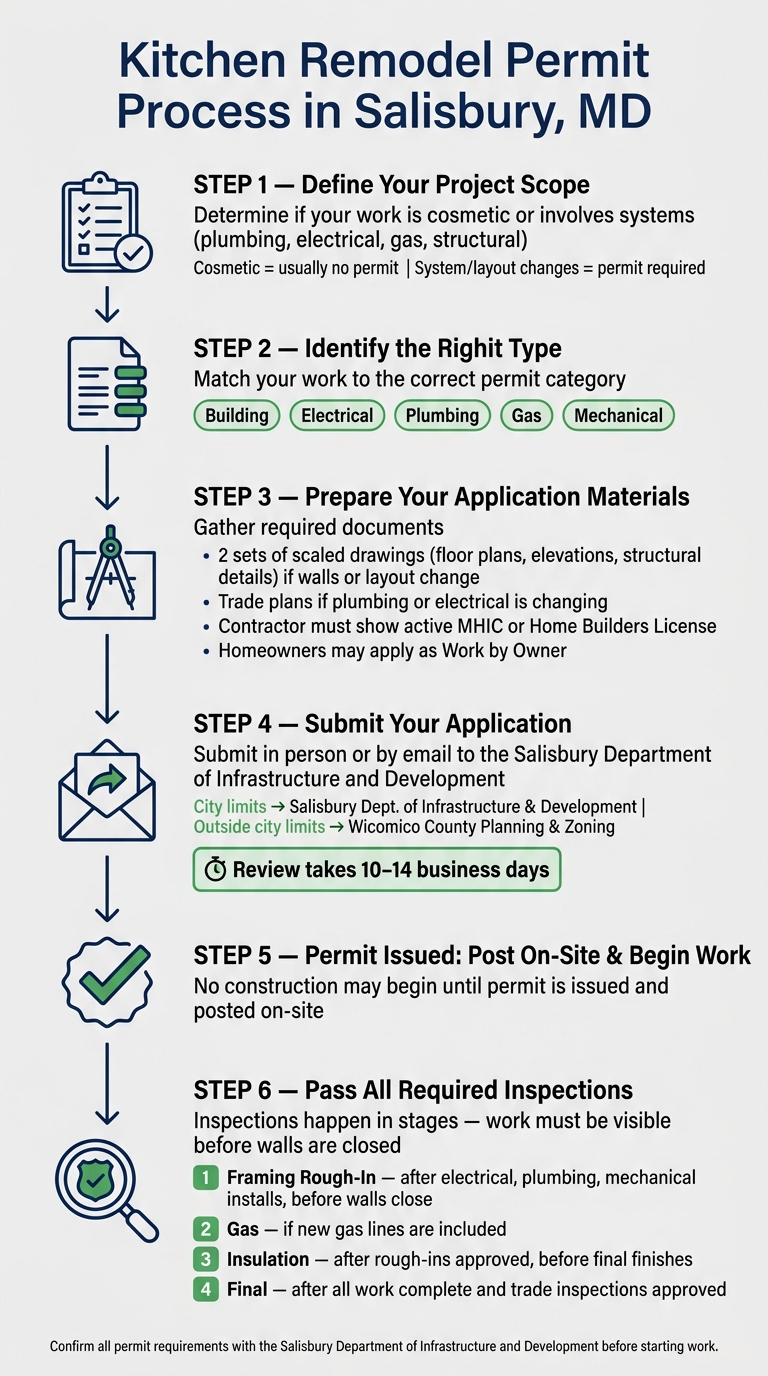
Salisbury, MD Kitchen Remodel Permit Process: Step-by-Step Guide
When a bathroom remodel moves into building, plumbing, electrical, or gas work, a permit has to be filed before any work starts. The application can be submitted by the owner, contractor, architect, or engineer.
For contractor-led jobs, there’s a firm rule here: the contractor must show proof of an active Maryland Home Improvement Commission (MHIC) or Home Builders License when the application is filed. If a homeowner wants to handle the job directly, they can apply as "Work by Owner". That route puts code compliance squarely on the homeowner.
Electrical permits are also open to homeowners doing their own electrical work in their own home.
No construction can begin until the permit is issued.
Once the scope is locked in, the next move is the permit application and inspection plan. Start with the full scope of work. If the project changes walls or shifts the layout, you’ll need two sets of scaled drawings that show dimensions, openings, and structural details. If plumbing or electrical is changing, trade plans are usually part of the package too.
Applications can be submitted in person or by email to the Department of Infrastructure and Development. In Wicomico County, permit processing usually takes 10 to 14 business days.
After the permit is issued and posted on-site, construction can start. From there, inspections happen in stages. Think of it like checkpoints. The county wants to see the work before it gets covered up, not after tile and drywall hide everything.
| Inspection Phase | When It Happens |
|---|---|
| Framing Rough-In | After electrical, plumbing, and mechanical installations are completed and approved, but before walls are closed |
| Gas | Required if any new gas lines or service are part of the project |
| Insulation | After rough-ins are approved and before final finishes go in |
| Final | After all work is complete and final trade inspections are approved |
Final approval happens after the last inspection.
Not every kitchen remodel lands in the same permit bucket. A paint-and-flooring update is one thing. Moving plumbing, adding circuits, or taking out a wall is a whole different job.
Use these common project scopes to line up your remodel with the permit path that usually fits. The goal is simple: know what work tends to trigger permits, and know which inspections are likely to show up along the way.
The table below lays out the usual permits and inspection points for each scope.
| Scenario | Typical Work Included | Likely Permits | Key Inspection Points |
|---|---|---|---|
| Cosmetic Refresh | Cosmetic only: painting, flooring, backsplash, same-location cabinet/counter replacement, like-for-like appliance swaps | None (usually permit-free) | N/A |
| Mid-Level Update | Plumbing/electrical changes: moving the sink and adding new electrical circuits, dishwasher relocation or new dishwasher line | Plumbing, Electrical | Rough-in (plumbing/electrical), Final |
| Full Reconfiguration | Structural/system changes: wall removal, island with power, gas range installation, new exterior door | Building, Electrical, Plumbing, Gas, Mechanical | Framing, Gas pressure test, Rough-in, Final |
Check first whether your property is inside Salisbury city limits or in unincorporated Wicomico County. That one detail decides where the permit goes.
Within the city, permits are handled by the City of Salisbury Department of Infrastructure and Development. Outside city limits, Wicomico County handles permits instead.
Not sure which side your property falls on? Look at the property’s legal description, or call to confirm:
A two-minute phone call here can save you from filing with the wrong office.
If your kitchen remodel in Salisbury, MD, needs a permit and work starts without one, the fallout can get expensive fast.
The City may issue a Stop Work Order and force the job to pause on the spot. That usually means delays, rescheduling, and extra labor costs you didn't plan for. On top of that, permit fees can go up once the work has already started.
There's more. You could face daily fines, and the City may require unpermitted work to be removed or redone at your expense. If walls are closed up before inspection, parts of the project may need to be opened back up so the work can be checked.
This doesn't always end when construction ends, either. Unpermitted work can create problems during a future home sale, especially when buyers, agents, or inspectors start asking questions. It may also lead to insurance claim denials if a later issue ties back to work that wasn't approved.
Yes. If your kitchen remodel includes electrical, plumbing, or gas work, you’ll usually need separate permits for each of those systems.
In Salisbury and Wicomico County, work like moving plumbing, adding a gas line, or installing new electrical outlets often requires permits and inspections. Those permits are commonly filed as separate applications, along with any main building permit tied to structural changes.
