
Living on the Eastern Shore means your kitchen cabinets face challenges like high humidity, fluctuating temperatures, and salt air from the Chesapeake Bay. These factors can cause warping, swelling, and corrosion if the wrong materials are chosen. Here's a quick breakdown of how popular cabinet materials perform:
Quick takeaway: For Eastern Shore kitchens, marine-grade plywood for cabinet boxes and sealed MDF or PVC for doors balance durability, cost, and style. Proper finishes and corrosion-resistant hardware are key to longevity.
Solid wood cabinets are a timeless option, prized for their natural beauty, strength, and durability, often lasting 30–50 years. However, living on the Eastern Shore brings unique challenges to consider.
Solid wood naturally absorbs and releases moisture, which means it expands and contracts with the Eastern Shore's seasonal humidity shifts. Over time, this can lead to sticking doors, small cracks in finishes, or noticeable gaps at door joints. But not all wood species react the same way. Rift-sawn white oak and walnut, with their tighter, linear grain patterns, are much better at resisting seasonal movement than flat-cut options.
The construction quality of solid wood cabinets plays a big role in their durability. Cabinets built with proper joinery, like dovetail joints, hold up far better under daily wear than those assembled with staples or cam locks. For kitchens that see heavy use, harder wood species like Hard Maple (Janka hardness: 1,450 lbf) and Hickory (1,800–2,100 lbf) are excellent choices for resisting dents. On the other hand, softer woods like Alder (590 lbf) are better suited for spaces with lighter use.
Solid wood cabinets demand more care than engineered alternatives. The finish is crucial - it acts as the main barrier against moisture, not the wood itself. Factory-applied finishes like catalyzed conversion varnish or UV-cured coatings provide a tougher, longer-lasting shield than paint applied on-site. If the surface gets chipped or scratched, it’s important to repair it quickly, as exposed wood can absorb moisture rapidly. The upside? Unlike MDF or particleboard, solid wood can be sanded and refinished, giving it a second life if damaged. While maintenance can be a bit more involved, the long-term value of solid wood makes it worthwhile.
Solid wood cabinets require a higher initial investment, but their longevity makes them a smart choice in the long run. When properly cared for, they can last for decades. As John Clark of At Design Remodel explains:
"While solid wood costs more upfront, the long-term durability and timeless beauty make it the best investment for a lasting kitchen remodel."
One of solid wood's standout features is its ability to showcase natural grain patterns, making it ideal for stained finishes. With options like maple, cherry, oak, alder, and walnut, solid wood works well with nearly any cabinet style, from classic raised-panel designs to sleek Shaker or furniture-grade inset styles. However, if you're aiming for a perfectly smooth painted finish, keep in mind that even well-sealed solid wood may show faint grain lines over time.
When it comes to cabinet boxes in coastal kitchens, plywood stands out as a reliable choice. Its cross-layered construction - thin wood veneers glued with alternating grain directions - offers excellent stability, helping it resist warping and swelling in fluctuating humidity levels. For Eastern Shore homes, where indoor humidity often ranges between 50% and 70%, this stability becomes essential. In these environments, where salt air and moisture test every material, plywood’s performance is especially important. Here’s a closer look at how standard and marine-grade plywood compare in terms of moisture resistance, durability, maintenance, cost, and design flexibility.
Standard plywood is moisture-resistant to a degree but can still absorb humidity over time due to its hygroscopic nature. Marine-grade plywood takes moisture protection a step further. It’s manufactured with waterproof adhesives and has minimal internal voids, which makes it less likely to delaminate when exposed to damp conditions. Peter Chambers, Associate Editor at Renovated.com, highlights this advantage:
"Marine-grade plywood is the prime choice for coastal and humid climates as an engineered wood panel manufactured to withstand moisture."
Marine-grade plywood often uses water-resistant tropical woods like teak, making it more resistant to mold and pests - key benefits in high-humidity coastal areas. While standard plywood performs adequately in many settings, spaces with frequent moisture exposure, such as near sinks or dishwashers, benefit from the added protection marine-grade options provide. Another plus? Plywood holds screws better than particleboard, ensuring stronger, longer-lasting cabinet structures.
"In South Carolina's coastal environment, [plywood box construction] is not a luxury upgrade - it is a baseline quality requirement." - Charleston Design Center
Plywood cabinets require minimal upkeep, but a little care goes a long way in extending their lifespan. Sealing edges - especially on shelves and door backs - with edge banding or a waterproof finish helps block moisture. Regularly wiping down surfaces keeps corrosive salt particles at bay, preventing damage to finishes and hardware. Using kitchen exhaust fans during cooking also reduces steam buildup around cabinets, preserving their condition.
Marine-grade plywood comes with a higher price tag than standard cabinet-grade plywood, but its durability in coastal settings often makes it a worthwhile investment. It can last 20–30 years or more, compared to the 10–15-year lifespan of more budget-friendly alternatives. For those looking for a cost-conscious option, exterior-grade plywood offers a middle ground. It uses moisture-resistant glue, providing better protection than standard interior-grade plywood at a lower cost than marine-grade.
Plywood offers a solid base for various finishes like paint, stain, and wood veneers, making it adaptable to a wide range of design styles - from laid-back coastal vibes to polished, furniture-grade looks. While the plywood itself is typically hidden in finished cabinetry, pairing it with durable, corrosion-resistant hardware - such as 316 marine-grade stainless steel or solid brass - ensures the entire cabinet system holds up against the challenges of salt air over time.
MDF, or medium-density fiberboard, is made by compressing softwood fibers, resin, and wax into smooth, uniform sheets. While it's known for its sleek finish, it doesn't hold up well in humid or wet conditions.
Standard MDF has a tendency to absorb moisture, especially in coastal kitchens where humidity often ranges between 50% and 70%. This can lead to swelling and deterioration over time. Moisture-resistant options like Medex (rated MR50) offer better performance, but even these aren't recommended for areas prone to standing water, such as sink bases or around dishwashers.
In typical conditions, MDF cabinets last around 15–20 years, which is shorter than the 20–30+ years you can expect from plywood. High humidity accelerates wear, especially if the edges aren't sealed properly. Once moisture or impact damages the core, MDF can't be repaired or refinished. For structural components in a coastal kitchen, MDF isn't usually the best option.
"In coastal areas, standard MDF is prone to swelling if exposed to moisture. It should be used for cabinet fronts or decorative parts - not for structural components - unless fully sealed." - AIS Cabinetry
Proper maintenance can help extend the life of MDF cabinetry. It's essential to seal all sides of each panel and keep indoor humidity below 60% using air conditioning or a dehumidifier. Spills should be cleaned up immediately, and factory-applied finishes like catalyzed lacquer or conversion varnish are recommended for their moisture-resistant properties.
MDF is the most budget-friendly option compared to plywood and solid hardwood. However, in coastal environments, its susceptibility to moisture can shorten its lifespan. A hybrid approach is often recommended for homes on the Eastern Shore: using plywood for structural cabinet boxes and MDF for door fronts. This combination balances MDF's smooth, painted finish with plywood's superior moisture resistance.
One of MDF's standout features is its smooth, paintable surface. Unlike natural wood, it doesn't have a grain, which means paint adheres evenly without showing texture or cracking at joints. This makes MDF an excellent choice for homeowners seeking sleek, painted cabinets.
"MDF is really good at one thing: Staying flat and painting smooth. If you want a clean painted cabinet door with no grain telegraphing through, MDF is your friend." - Austin Rohrer, General Contractor, Rohrer for Construction
MDF works particularly well for Shaker-style center panels and flat slab doors. When paired with a cabinet box made from a more moisture-resistant material, the result is both visually appealing and durable. Next, we'll take a closer look at laminate and PVC cabinets as other options for coastal kitchens.
Laminate and PVC cabinets each bring unique advantages to kitchens in coastal areas. Knowing how they differ can guide you in making the best choice for your Eastern Shore home.
PVC cabinets are completely waterproof, making them ideal for areas with high humidity. They resist moisture absorption, warping, and mold growth - even when indoor humidity levels remain between 50% and 70%, which is typical for coastal homes. Laminate surfaces are naturally resistant to moisture, but their performance depends heavily on pairing with a High Moisture Resistant (HMR) core for durability.
"The laminate surface might resist moisture, but if the core is particleboard, the edges and joints will fail first." - Cabinets & Remodeling Depot
This ability to handle moisture is a key factor in their overall durability.
Laminate cabinets with a standard particleboard core typically last 7–15 years in humid environments. Thermally Fused Laminate (TFL) improves durability by bonding its decorative surface directly to the board, creating a finish resistant to swelling and heat expansion. PVC cabinets, on the other hand, are entirely sealed and immune to humidity-related damage like rot or delamination. However, lower-grade thermofoil options (vinyl wraps over MDF) may show wear - such as yellowing, chipping, or peeling - within 3–5 years.
For homes on the Eastern Shore, where humidity and salt air can speed up wear and tear, both options offer practical benefits. They’re also easier to clean of salt residue compared to natural wood, making them a low-maintenance choice for coastal living.
Both laminate and PVC cabinets are easy to maintain. A simple wipe with a damp cloth removes grime, and neither requires extra treatments like sealants or refinishing. For laminate, it’s important to ensure panel edges are sealed to prevent moisture intrusion. Running an exhaust fan for 15 minutes after cooking can also help reduce kitchen humidity.
Laminate cabinets are a cost-effective option for full kitchen remodels, while PVC is better suited for areas exposed to moisture. As Sinclair Cabinets explains:
"Laminate is its blend of affordability and toughness. It delivers a consistent, easy-to-clean surface that can handle the chaos of a busy kitchen."
For homeowners on the Eastern Shore, a combination approach often works best. Use PVC for high-moisture areas like beach entryways, laundry rooms, or outdoor kitchens, and opt for laminate with a moisture-resistant core throughout the main kitchen.
Laminate cabinets shine when it comes to variety. Thermally Fused Laminate (TFL) is available in a wide range of colors, woodgrain patterns, stone textures, and abstract designs. Modern PVC has also come a long way, offering convincing woodgrain finishes and sleek painted looks in matte or high-gloss options.
Here’s a quick comparison of the two materials for coastal kitchens:
| Factor | Laminate (TFL/HPL) | PVC Cabinets |
|---|---|---|
| Moisture Resistance | High surface resistance; core-dependent | 100% waterproof; immune to humidity |
| Durability | Resists heat; edges may peel if unsealed | Won’t rot, warp, or support mold |
| Longevity | 7–15 years depending on core quality | 10–15 years typical for imported lines |
| Maintenance | Low; easy to wipe clean | Minimal; salt- and mold-resistant |
| Aesthetic Range | Excellent; many colors and textures | Good; modern wood-mimicry or solid colors |
| Best Use | Kitchens with good ventilation and HMR core | Wet zones, laundry rooms, outdoor kitchens |
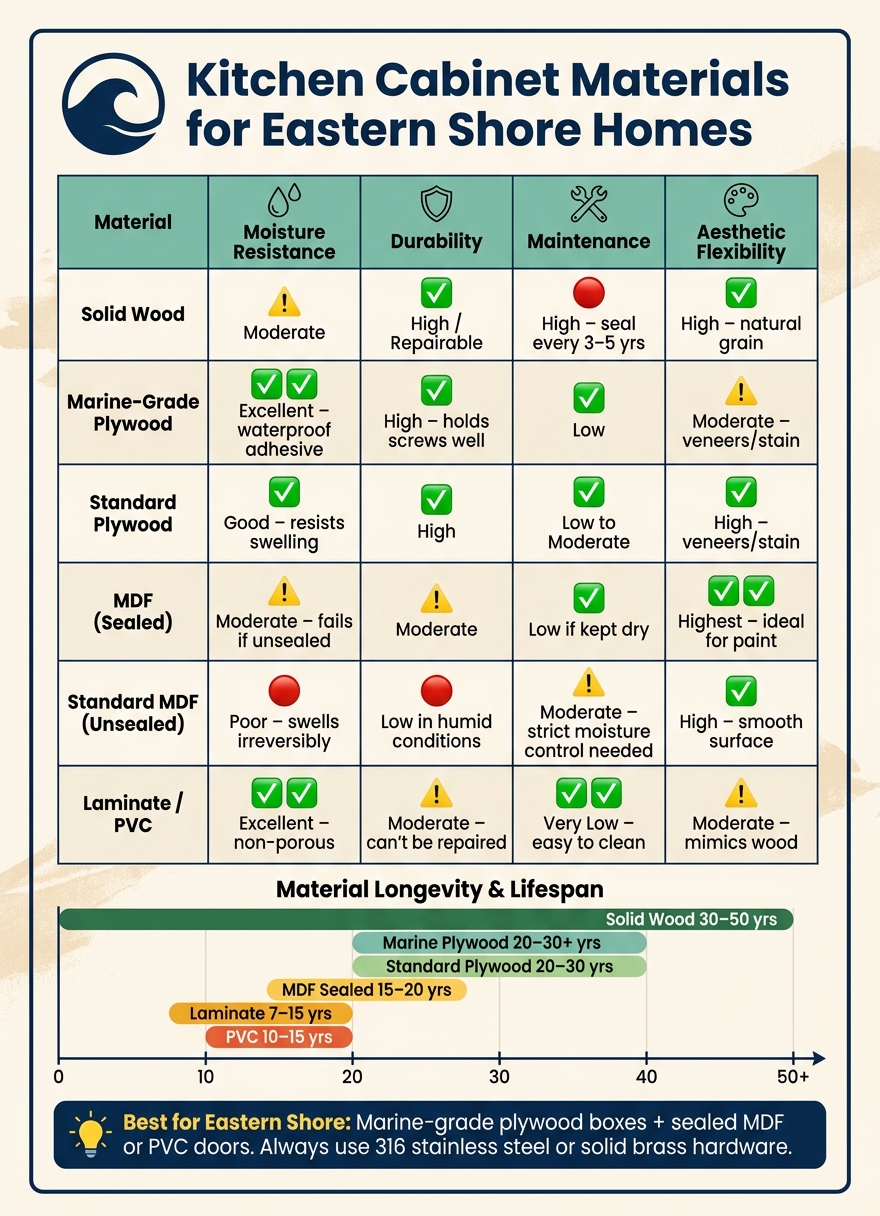
Kitchen Cabinet Materials for Coastal Homes: Side-by-Side Comparison
When choosing cabinets for Eastern Shore kitchens, understanding the strengths and weaknesses of different materials is key. Here's a closer look at how each option performs in this environment.
Solid wood stands out for its classic appeal and durability, often lasting 30–50 years with proper care. However, it’s prone to expanding and contracting with humidity. As John Clark of DRS explains:
"While solid wood costs more upfront, the long-term durability and timeless beauty make it the best investment... The cost per year is often lower than replacing cheaper cabinets twice."
For coastal homes, species like rift-sawn white oak or teak are better suited than flat-cut varieties, though they still require oil-based sealants and regular upkeep.
Plywood is a dependable choice for humid climates due to its moisture-resistant construction. Marine-grade plywood, in particular, uses waterproof adhesives and eliminates internal voids that can trap moisture. However, it lacks the perfectly smooth surface required for painted finishes, which MDF provides.
MDF excels in offering a smooth, flawless surface for paint. However, standard MDF is highly susceptible to moisture damage, making unsealed panels a risky option for coastal kitchens. This is why many homeowners turn to hybrid solutions.
A hybrid approach - combining plywood boxes for structural strength with sealed MDF door panels for a smooth, paint-ready finish - is a practical choice for many Eastern Shore homes.
Here’s a comparison of how these materials fare in coastal conditions:
| Material | Moisture Resistance | Durability | Maintenance | Aesthetic Flexibility |
|---|---|---|---|---|
| Solid Wood | Moderate (expands/contracts with humidity) | High; repairable | High; requires sealing every 3–5 years | High; natural grain |
| Marine Plywood | Excellent; waterproof adhesive, no voids | High; holds screws well | Low | Moderate; veneers/stain |
| Standard Plywood | Good; resists swelling | High | Low to moderate | High; veneers/stain |
| MDF (Sealed - all six sides protected) | Moderate; fails if unsealed | Moderate | Low if kept dry | Highest; ideal for paint |
| Standard MDF (unsealed) | Poor; swells irreversibly | Low in humid conditions | Moderate; requires strict moisture control | High; smooth surface |
| Laminate / PVC | Excellent; non-porous | Moderate; can’t be repaired | Very low; easy to clean | Moderate; mimics wood |
No matter the material, using moisture-resistant hardware is essential for coastal durability. Corrosion-resistant options, such as 316 marine-grade stainless steel, are a must. As EuroTech Cabinetry emphasizes:
"The cabinetry that holds up is the cabinetry that was specified correctly from the beginning."
Choosing the right combination of materials and hardware at the outset can mean the difference between cabinets that last a decade and those that endure for generations.
Selecting the ideal cabinet material for an Eastern Shore kitchen means considering your home's proximity to water, how much maintenance you're willing to handle, and the look you're after. Moisture resistance, durability, and upkeep all play a big role in making the right choice.
For homes near the Chesapeake Bay or in tidal zones, marine-grade plywood boxes are a dependable option. These resist swelling in damp conditions and can be paired with sealed MDF for a sleek painted finish or rift-sawn white oak for a sturdy, natural appearance.
If your kitchen faces constant moisture or salt air, PVC or laminate cabinets shine. While they aren't the easiest to repair, their ability to withstand humidity and salt makes them a smart pick for such environments.
For homes with less exposure to moisture, standard plywood boxes with MDF painted doors strike a good balance between style and durability. And don't skimp on the hardware - corrosion-resistant materials and factory-applied finishes are, as EuroTech Cabinetry emphasizes, "a vital investment for lasting performance."
Finally, keeping indoor humidity between 30–55% throughout the year will help ensure your cabinets hold up against Maryland's humid summers and dry winters. Ready to upgrade your Eastern Shore kitchen? OC Home Services works with homeowners across the Delmarva Peninsula on kitchen remodels built for the coastal climate — from cabinet selection through final installation.
For homes close to the Chesapeake Bay, marine-grade plywood is the go-to choice for cabinet boxes. Its ability to resist moisture and swelling makes it ideal for the humid conditions of the area. When it comes to cabinet doors, materials like moisture-resistant MDF or composites with multi-layer catalyzed finishes stand up well to humidity. On the other hand, standard particleboard should be avoided - it doesn’t hold up in damp environments and is prone to damage. For hinges and hardware, 316 marine-grade stainless steel is the best option, as it resists corrosion caused by salt air.
In kitchens where humidity is a concern, plywood is the go-to choice for structural elements like cabinet boxes, especially around sinks and dishwashers. Its ability to handle moisture makes it far more reliable in these areas. On the other hand, MDF works well for decorative features like door panels or fronts, thanks to its smooth surface, which takes paint beautifully. If you opt for MDF, make sure it’s moisture-resistant (MR-MDF), but steer clear of using it for structural components in damp spots.
To keep rust at bay in salty air, opt for materials that can stand up to the elements. Marine-grade 316 stainless steel, solid brass, or durable powder-coated finishes are excellent choices, especially for oceanfront properties. Steer clear of plated or zinc-plated hardware - they tend to rust in no time.
Regular upkeep is key. Wipe away salt buildup frequently, check hinges and slides annually for any signs of wear, and ensure your kitchen is well-ventilated to manage humidity, which speeds up corrosion. These steps can help extend the life of your hardware in coastal environments.
