
Most Eastern Shore owners choose a walk-in shower in the primary bath and keep at least one tub somewhere else in the home. That setup fits daily use, helps with aging at home, and avoids losing buyer interest later.
If you are deciding between a walk-in shower and a soaking tub, the short answer is simple: showers usually fit primary homes and rentals better, while tubs still matter in family homes and larger suites. On Delmarva, the choice also depends on coastal moisture, cleaning time, safety, room size, permits, and how the property gets used year-round.
Quick Comparison
| Criteria | Walk-In Shower | Soaking Tub |
|---|---|---|
| Best for | Primary baths, rentals, older owners | Family homes, large primary suites |
| Entry and safety | Low-threshold or curbless options | High wall to step over |
| Space use | Fits tighter layouts | Needs more floor space |
| Cleaning | Less upkeep, especially with acrylic walls | More scrubbing around basin and tile |
| Coastal moisture | Acrylic systems handle humidity better | Tile and grout need more care |
| Resale role | Strong in primary suites | Good to keep at least one tub in the home |
| Daily use | Often used more | Often used less unless kids or bath lovers use it |
Two numbers shape this decision fast: about 25% of remodeling owners remove a tub, and 78% of buyers say a shower and tub in the primary bath is essential or desirable. That is why many local remodels land in the middle: shower where you use it most, tub where the house still needs one.
The rest of the article breaks that choice down by property type, layout, upkeep, and local Eastern Shore conditions.
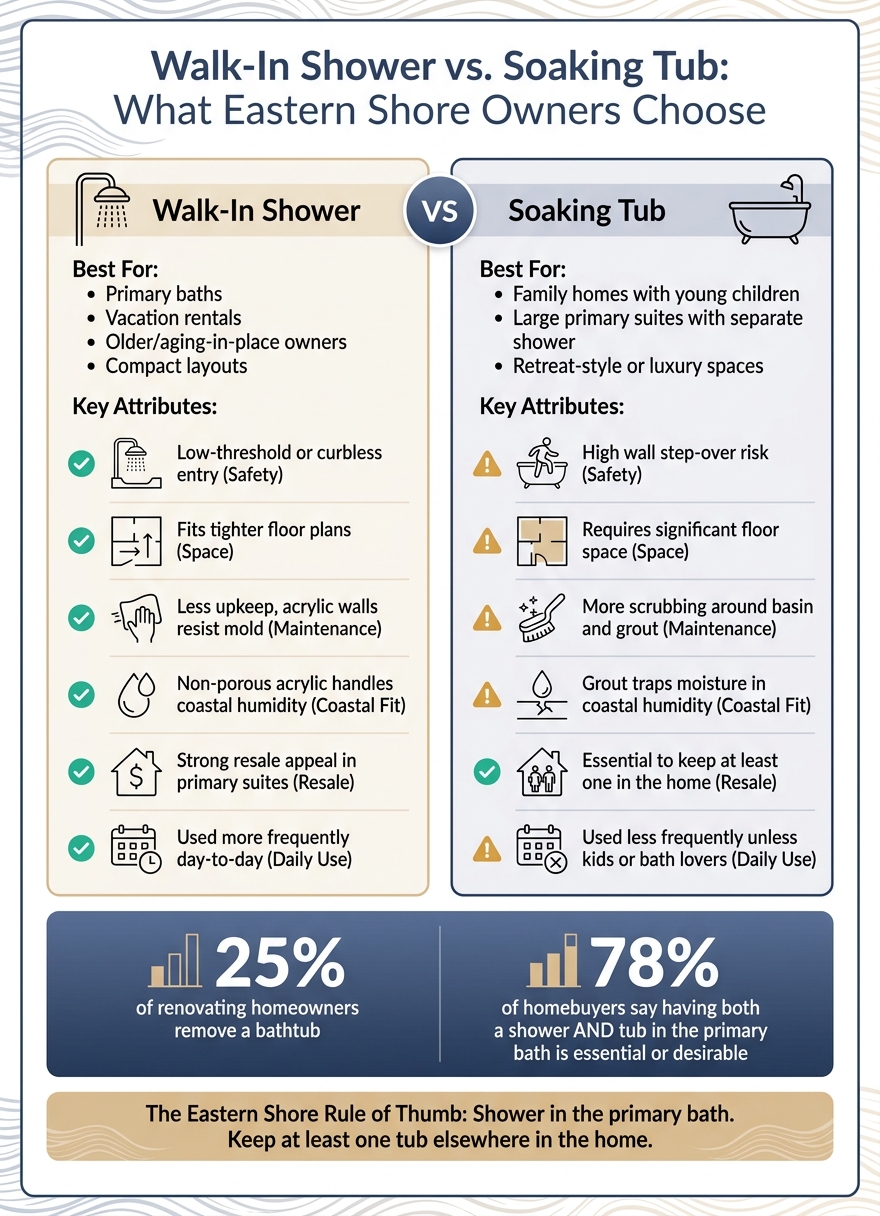
Walk-In Shower vs. Soaking Tub: Eastern Shore Bathroom Comparison
The choice usually comes down to three things: who uses the bathroom, how often they use it, and how much room the layout can spare. Moisture control matters too, especially in homes near the coast. Those tradeoffs land differently in primary homes, family homes, and vacation properties.
| Feature | Walk-In Shower | Soaking Tub |
|---|---|---|
| Accessibility | High; curbless or low-threshold entry | Low; stepping over high walls is a hazard for seniors |
| Space Needs | Flexible; fits compact older layouts | High; requires significant floor space and plumbing needs |
| Maintenance | Low, especially with grout-free acrylic surfaces | Moderate; large basin and surrounding tile require regular scrubbing |
| Moisture Performance | Excellent with non-porous acrylic surrounds | Moderate; grout lines can trap moisture and mildew in coastal humidity |
| Resale Appeal | Strong for primary suites, seniors, and rental properties | High for family homes with young children |
| Best Fit | Primary suites, vacation rentals and second homes | Family homes and higher-end primary suites |
In older Salisbury and Wicomico County homes, bathroom space is often tight. A walk-in shower solves a simple problem: it takes up less visual and physical space, and it gets rid of the step-over edge that makes tubs harder to use with age.
For homeowners planning to stay put, that matters. A curbless entry with grab bars can support aging in place without making the room feel like a medical setup. It still looks like a modern bath, just one that works better day to day. About 25% of renovating homeowners choose to remove a bathtub, and most use that extra room to make the shower larger instead.
A soaking tub makes the most sense in a large primary suite that already includes a separate shower. If the home has the square footage, the plumbing setup, and the budget for it, a tub can fit the plan well. In that case, it’s less about daily function and more about building a retreat-style space.
Without a separate shower in the design, though, a soaking tub usually asks for too much floor space for too little daily use. That math changes once you look at how the home is used year-round, whether kids share the bath, or whether guests rotate through the property.
Taking out the only bathtub can hurt resale. 78% of homebuyers say having both a shower and a tub in the primary bath is essential or desirable. That’s why many local owners follow a pretty simple rule: if the primary bath needs to become a walk-in shower, keep a tub somewhere else in the house.
Most often, that means a hallway bath or secondary bathroom keeps the tub. In Delmarva homes, that’s usually the point where the decision gets less about style and more about property type, daily use, and who the home needs to work for.
By property type, Delmarva owners tend to make three different choices. The bathroom that works in a year-round home often falls short in a rental, and what makes sense for a family house may not fit an older Eastern Shore property.
In older Eastern Shore homes, many owners swap the primary tub for a walk-in shower to open up the room, make access easier, and cut down on upkeep. Non-porous acrylic wall systems often win out over tile because they hold up better against the mold and mildew that coastal humidity and salt air can trigger in grout lines. For owners who plan to stay put for years, a low-threshold or barrier-free entry can also help with aging-in-place.
That thinking changes a bit when resale or guest use starts to matter more.
Family homes usually keep a tub-shower combo in a hall or secondary bath, even if the primary bath gets upgraded to a walk-in shower. That extra tub still serves a clear purpose. It works for children, visiting grandchildren, and future buyers who want at least one tub in the house.
Keeping the hall-bath tub helps protect the home's appeal without giving up the comfort of a more modern primary shower.
Vacation properties tend to narrow the decision down to durability and fast cleaning. In Ocean City condos and rentals, walk-in showers with frameless glass are a common pick because they clean up fast between guest stays.
Owners with family-focused bookings often keep one tub-shower combo in a secondary bathroom. Scratch- and stain-resistant acrylic is a strong fit for these spaces because it holds up well through busy rental seasons in a coastal setting.
Once you know the property type, local conditions usually settle the layout. On the Eastern Shore, the call often comes down to safety, moisture, and timing.
For long-term owners, a curbless or low-threshold shower is often the safer pick. That's why walk-in showers show up so often in primary-bath remodels meant for aging in place. A high tub wall isn't just a small hassle. It's a real step-over risk, especially for older adults.
"The hazardous threshold of a traditional tub kills hundreds of people every year... for seniors, especially those in an aging in place situation, curbless walk-in showers are the safer and easier option." - Shyam Ronvelia, Marketing Coordinator, Revive Real Estate
If you're bathroom remodeling now, it's smart to plan ahead. Install wall blocking for future grab bars while the walls are open. Add a bench. Use slip-resistant flooring. Those upgrades don't get much attention in glossy design photos, but they matter day to day.
Coastal bathrooms play by different rules. Grout is often the weak spot. In Delmarva's humidity, tile grout absorbs moisture and can start holding mildew fast. That's one big reason many coastal owners lean toward low-maintenance shower systems instead of tiled surrounds.
Non-porous acrylic wall systems help avoid that issue because they resist mold and remove grout lines that need constant scrubbing. It's not the flashy choice. It's the one that cuts down on upkeep.
Ventilation matters just as much. Whatever layout you choose, upgrade the exhaust fan during the remodel. In Delmarva bathrooms, skipped maintenance tends to hit harder and sooner, which often pushes owners toward showers over more labor-heavy tub setups.
"An Ocean City bathroom takes more abuse than almost any other bathroom on the East Coast. Salt air and humidity push in from the outside." - Baths by Spicer Bros
Before anything gets signed, check two things: license status and project timing.
In Maryland, homeowners must hire contractors licensed by the Maryland Home Improvement Commission (MHIC). Ask for the license number up front, then verify it yourself. Bathroom renovations in Worcester, Wicomico, and Dorchester counties also require building permits.
For vacation rental owners, the calendar can matter just as much as the budget. Work should be done before Memorial Day so you don't lose bookings during peak season. Fast, low-disruption shower installs can cut vacancy time. Scope matters here too. Soaking tubs usually take more time and more coordination than shower conversions. If a soaking tub is part of the plan, book that work for the off-season.
Once you weigh shower habits, tub appeal, and the extra upkeep that comes with coastal living, the choice usually comes back to the kind of home you have. Most Eastern Shore owners land on the same three filters: daily use, who lives in the home, and what future buyers may want.
For most Delmarva bathroom remodels, the plain answer is this: put a shower in the primary bath and keep at least one tub somewhere else in the house.
Choose a walk-in shower for your primary bath: it is easier to maintain and safer for daily use. Add a soaking tub only if it matches how you live day to day, not just how it looks in photos.
Keep at least one tub somewhere else in the home to protect buyer appeal.
For vacation rentals, a durable, easy-to-clean walk-in shower with non-porous acrylic walls is usually the better fit for turnover and coastal humidity.
OC Home Services can help you plan the layout, materials, and build details for a Delmarva bathroom remodel.
Generally, no. Removing your home’s only bathtub is often a bad bet, and it can hurt resale value.
A safer move is to keep at least one tub in a secondary or hall bathroom, then upgrade the primary bath with a modern, accessible walk-in shower. That gives families the tub they may still want while giving your home the updated look many buyers like.
Yes. A walk-in shower is often the better fit for aging in place because its barrier-free entry gets rid of the high step you have with a standard tub. That simple change can help lower fall risk.
It can also include safety features like grab bars, fold-down seating, and non-slip surfaces - all while helping you keep your independence and your bathroom’s style.
On the Eastern Shore, salt air and high humidity speed up mold and mildew. Non-porous acrylic usually holds up best because it has no grout lines, resists scratches and stains, and cleans up without much fuss.
That matters more than people think. Tile depends on grout, and grout traps moisture. Fiberglass has its own problems with heavy guest use, including pitting, yellowing, and surface wear.
