
Most bathroom storage jobs are simple only until they touch a wall, tile, plumbing, or wiring.
If your storage stays on the surface - like freestanding shelves, drawer organizers, under-sink bins, adhesive hooks, or over-toilet units - you can usually handle it yourself. If it means cutting drywall, drilling into shower tile, changing a vanity, adding a lighted mirror, or building a shower niche, you need a contractor.
In Eastern Shore homes, that line matters more because older walls often hide pipes, wires, and uneven framing, and coastal moisture can ruin the wrong materials fast. Bathrooms with damp air and low airflow are more likely to have mold, rust, finish failure, and shelf swelling - especially in vacant homes that sit closed up for weeks or months.
Short answer:
A few fast checks can keep the choice clear:
Quick Comparison
| Storage type | DIY or contractor? | Main reason |
|---|---|---|
| Freestanding shelves | DIY | No wall access |
| Over-toilet cabinet | DIY | Surface install only |
| Drawer organizers | DIY | No demolition |
| Under-sink bins | DIY | Works around existing pipes |
| Adhesive hooks | DIY | No drilling needed |
| Shower caddy | DIY | Avoids cutting tile |
| Recessed medicine cabinet | Contractor | Wall opening and hidden utilities |
| Built-in shower niche | Contractor | Waterproofing and tile work |
| Vanity change with plumbing | Contractor | Drain and supply connections |
| Lighted mirror with wiring | Contractor | Electrical work |
That is the basic split the full article explains: simple storage stays DIY; built-in or wet-area storage does not.
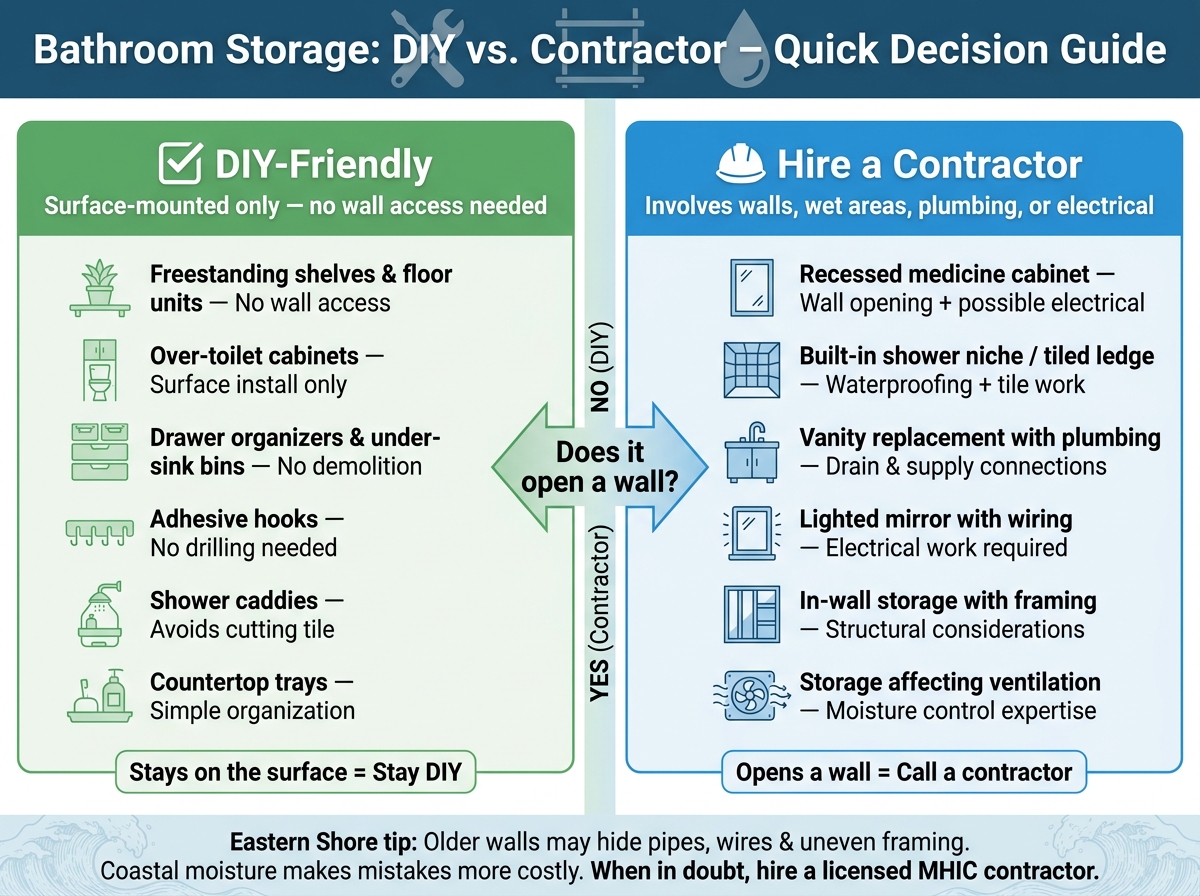
Bathroom Storage: DIY vs. Contractor – Quick Decision Guide
Start with surface-mounted pieces before you cut, drill, or tile. It’s the simplest way to add storage without getting into walls or touching plumbing, electrical, tile, or waterproofing.
Freestanding shelves, over-toilet cabinets, and slim floor units are often DIY-friendly because they don’t require changes behind the wall and usually stay clear of plumbing. Before you buy, check the space around the toilet tank lid and flush handle. A piece that looks fine online can turn into a daily annoyance fast.
If the unit is tall, anchor it to a wall stud. That matters even more on uneven floors, where a narrow cabinet can get wobbly.
Drawer inserts, pull-out baskets, stackable bins, and under-sink organizers help you use the vanity you already have. No demolition. No mess. Just better use of space.
Under the sink, leave room for the drain pipe and supply lines. That area always looks bigger when it’s empty than it does once the organizer goes in. Countertop trays also help by keeping small items in one spot, which makes the counter easier to wipe down.
In shower areas, the safe move is storage that doesn’t disturb the waterproofing. Tension-mounted caddies, adhesive hooks, and basic wall shelves can handle light storage as long as you avoid drilling into wet-area tile.
Install them on clean, dry surfaces, and don’t push past the posted weight limit. That’s where these setups usually fail - not because the product is bad, but because it’s holding more than it should.
Once storage involves walls, tile, or wiring, it moves into contractor territory.
Surface storage is still DIY territory. Once a project opens a wall, touches plumbing, or changes wiring or venting, it stops being a simple weekend job and starts calling for a contractor.
That shift matters even more in older, moisture-prone bathrooms. A shelf is one thing. Cutting, tiling, and utility work is another. When storage starts affecting what sits behind the wall, DIY usually stops making sense.
A recessed medicine cabinet can seem simple at first glance. Cut the drywall, slide it in, and you're done.
In older bathrooms, it rarely goes that smoothly. Walls can hide wiring, supply lines, vent pipes, or odd framing that you won't see until the wall is open. If the wall is load-bearing, that opening can turn into a structural issue fast. The cutout also has to be framed the right way, sealed cleanly, and protected from moisture.
Built-in shower niches and tiled ledges need proper waterproofing, slope, and tile installation. Miss any part of that, and water can slip behind the tile.
On the Eastern Shore, that risk hits harder. Bathrooms here need extra attention to moisture control, and that takes plumbing know-how and waterproofing skill. This is the kind of job that can look neat on day one and cause hidden damage later if the prep work is off.
Vanity changes often sound like storage upgrades, but they tend to affect more than storage. They can shift plumbing, electrical, and ventilation at the same time.
The moment a vanity change affects drain lines or wiring, the project moves into contractor territory. Custom built-ins can also involve finish carpentry plus plumbing or electrical work behind the scenes. If storage ties into plumbing, power, or venting, it needs a contractor.
These are the lines that separate a DIY storage upgrade from work that should be handled by a pro.
Once a bathroom project moves past the surface and into walls, tile, or utility lines, make the call fast. Use one simple filter: does it stay on the surface, or does it open the wall? In older Eastern Shore bathrooms, especially ones dealing with damp air and wet zones, that split is a big deal.
Bring in a contractor if any of the following apply:
At that point, you're no longer in simple DIY territory. In Maryland, check for an active MHIC license before work starts, and if plumbing or electrical work is part of the job, verify those trade licenses too.
Use the chart below for a fast side-by-side check.
| Storage Project | DIY or Contractor? | Key Consideration |
|---|---|---|
| Freestanding shelves and floor units | DIY | No wall access |
| Drawer organizers and under-sink bins | DIY | Simple install |
| Adhesive hooks and shower caddies | DIY | Avoids wet areas |
| Recessed medicine cabinet | Contractor | Requires wall opening and possible framing or electrical work |
| Built-in shower niche or tiled ledge | Contractor | Wet-zone install; requires waterproofing and tile work |
| Vanity replacement affecting plumbing | Contractor | Involves plumbing connections and possible floor or wall repair |
| Lighted mirror or in-wall storage with wiring | Contractor | Requires electrical wiring and proper licensing |
For Eastern Shore bathrooms, this is where the decision usually gets clear. Older homes and moisture-prone spaces leave less room for guesswork.
OC Home Services is an MHIC-licensed home improvement company based in Salisbury, MD, serving the Eastern Shore and Southern Delaware. If your storage project touches carpentry, plumbing, or tile work, having one contractor handle the job can keep everything coordinated.
Use this checklist to make the decision fast.
A simple rule works well here: surface-mounted storage is usually a DIY job. If the project opens a wall, changes plumbing or electrical, or goes into a wet area, hire a contractor. In Eastern Shore bathrooms, humidity makes small mistakes more expensive.
For DIY, stick with items like freestanding shelves, slim floor units, drawer organizers, under-sink bins, and adhesive shower caddies. For contractor work, think recessed medicine cabinets, shower niches, custom cabinetry, and any storage connected to plumbing or electrical.
Once a storage project touches plumbing, tile, or wiring, it stops being a basic storage update. At that point, using one contractor to handle plumbing, carpentry, and tile can save headaches and keep the work on track.
Before you hire anyone, verify Maryland licensing and ask about workmanship warranties.
Match the storage choice to the bathroom’s layout, humidity, budget, and risk level. Use DIY for simple organization. Bring in a contractor when the project involves walls, wet areas, plumbing, or electrical work.
Drilling into bathroom tile can crack or chip the surface. Once that happens, water can get where it shouldn’t, damage the moisture barrier, and turn a small job into an expensive repair.
It might look like a simple DIY task. In practice, though, it takes the right tools, a steady hand, and the proper method for the tile you’re working with. OC Home Services can help you avoid damage to your bathroom finishes.
It’s tough to know what’s inside a wall just by looking at it. Pipes, wiring, and other lines sit behind the drywall, out of sight. A wall that looks empty may not be empty at all.
That’s where people get into trouble. One cut in the wrong spot can lead to water damage, electrical risk, or an expensive repair you didn’t see coming.
Have a licensed contractor check the wall before any work starts. They can use stud finders with electrical detection, inspection cameras, and blueprints to see what’s behind the surface before anyone opens it up.
Choose moisture-resistant materials if you want the space to hold up near the coast. Humidity and damp air can lead to warping, rot, and mold over time, so material choice matters more than most people think.
Ceramic and porcelain tile are a smart fit for wet areas. They’re non-porous, hold up well, and don’t need the kind of upkeep some other surfaces do.
For cabinets and shelving, high-quality composite or PVC-based materials usually perform better in coastal humidity than unfinished wood. If you want the look of wood, that can still work - just make sure it’s sealed well with a water-resistant finish.
