
A new exterior door can fail fast in Maryland if the frame, flashing, hardware, or permit steps are wrong.
Before you order a door, check four things: local code, frame condition, weather exposure, and contractor license status. In Maryland, home improvement work over $500 needs an MHIC-licensed contractor, and coastal homes may need wind-rated doors, impact-rated glass, reinforced anchoring, and salt-resistant hardware.
For most Maryland homes, the short answer is simple:
A few checks matter most before replacement:
| Option / Issue | Best Use | Main Risk | What to Check |
|---|---|---|---|
| Fiberglass door | Humid and coastal homes | Poor install can still lead to leaks | Frame, flashing, seals, hardware |
| Steel door | Security and inland or moderate exposure | Rust if coating fails | Finish condition and salt-safe hardware |
| Wood door | Lower-exposure locations | Warp, rot, paint breakdown | Distance from coast and upkeep needs |
| Impact-rated glass | Coastal and storm-exposed entries | Higher cost | Local wind and exposure rules |
| Slab-only replacement | Frame is square and dry | Missed hidden rot | Sill, jamb, header, gaps |
| Full-frame replacement | Rot, water damage, out-of-square opening | More labor and permit issues | Rough opening, flashing, anchoring |
If you want the plain version, it comes down to this: pick the right material for Maryland weather, confirm the opening is dry and square, and make sure the job meets local code before installation starts.
Maryland uses the IRC as its base code, then adds state changes through the Maryland Building Performance Standards (MBPS), with local changes layered on top. As of 2026, most Maryland jurisdictions point to the 2021 IRC, while some are moving to the 2024 edition. That sounds simple on paper. In practice, it means the rules can shift from one town or county to the next.
That local difference matters before you order a replacement door. The code may affect the opening size, door swing, landing space, and the hardware you’re allowed to use. A door that works in one jurisdiction may need changes in another.
Before you buy anything, check local rules for door width, swing, landing clearance, and how the latch operates. Those details shape what you can install, and they’re much easier to deal with before the order goes in.
A basic swap can turn into a permit job fast. If the work changes the opening, swing, or framing, a permit is usually required. For coastal homes, the door may also need to be wind-rated and impact-resistant to meet local exposure standards.
There’s also the contractor side of the job. For projects over $500, the contractor must hold an active MHIC license. The licensed contractor should pull the permit and stay responsible for code compliance. Once that part is nailed down, you can move on to the next choice: door material and hardware.
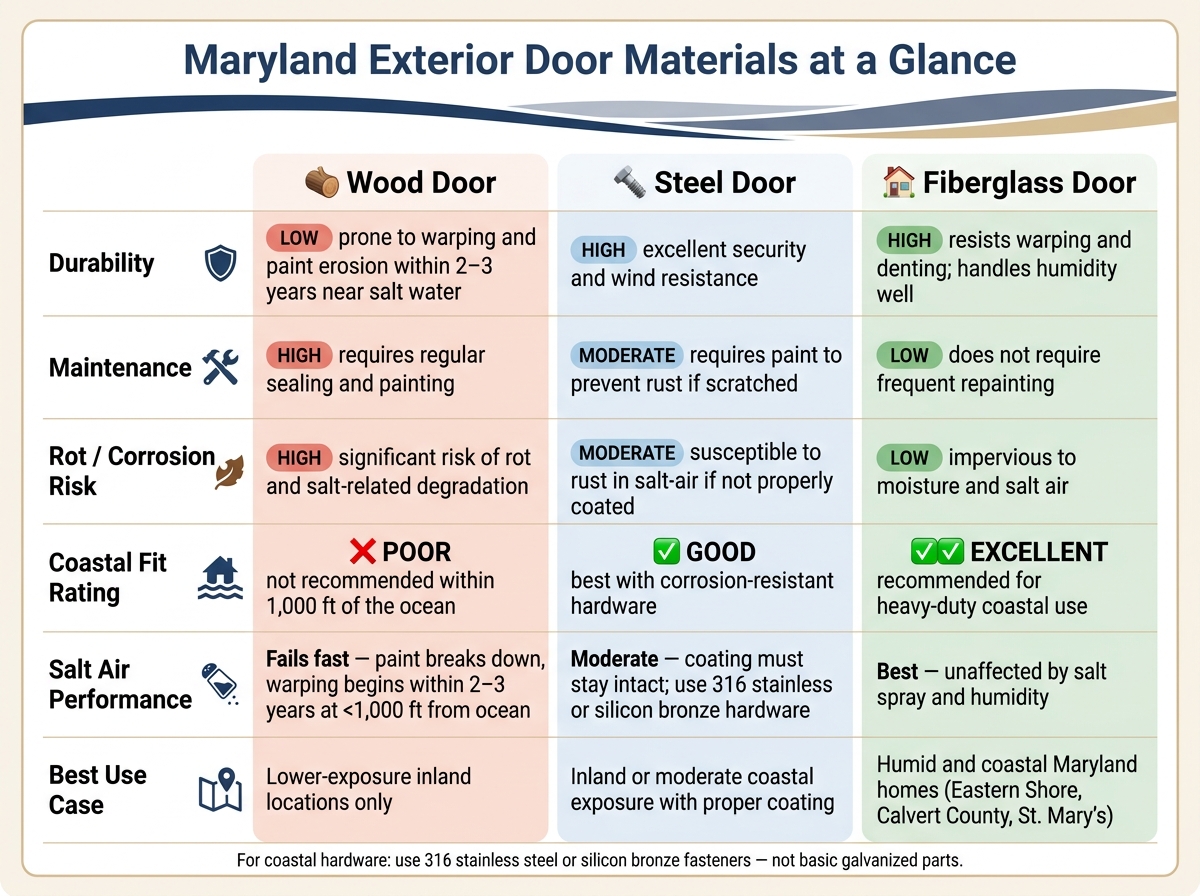
Maryland Exterior Door Materials: Fiberglass vs Steel vs Wood Comparison
Once code and permit questions are out of the way, the next call is the door itself: material, glass, and hardware. In Maryland's coastal areas - the Eastern Shore, Calvert County, and St. Mary's - a front door has to do more than look nice the day it's installed. Salt air, wind-driven rain, and higher wind-load demands are tough on exterior doors.
Wood is the weakest option in Maryland's coastal humidity. Salt wears down paint faster, and constant moisture swings can lead to warping within 2–3 years for homes within 1,000 feet of the ocean. Fiberglass and steel hold up much better in these areas, especially with corrosion-resistant hardware.
Hardware matters just as much as the slab. Use 316-grade stainless steel or silicon bronze fasteners. Galvanized fasteners break down fast in salt spray. A good door won't last if the screws, hinges, and other hardware can't deal with coastal air.
Here's the side-by-side view:
| Material | Durability | Maintenance | Rot/Corrosion Risk | Coastal Fit |
|---|---|---|---|---|
| Fiberglass | High; resists warping and denting; handles humidity well | Low; does not require frequent repainting | Low; impervious to moisture and salt air | Excellent; recommended for heavy-duty coastal use |
| Steel | High; provides excellent security and wind resistance | Moderate; requires paint to prevent rust if scratched | Moderate; susceptible to rust in salt-air environments if not properly coated | Good; best when used with corrosion-resistant hardware |
| Wood | Low; prone to warping and paint erosion within 2–3 years near salt water | High; requires regular sealing and painting to fight moisture | High; significant risk of rot and salt-related degradation | Poor; not recommended within 1,000 feet of the ocean |
The door material is only part of the story. Glass and insulation affect comfort, energy use, and storm performance. Energy savings, security, and storm protection all depend on the glass package, not just the outer surface of the door.
For energy performance, aim for a U-factor of 0.30 or lower and an SHGC of 0.25 to 0.40. That range helps balance winter heat retention with summer cooling in Maryland's mixed climate. Low-E glass coatings help on both fronts, and insulated door cores - usually polyurethane foam - add solid resistance to temperature swings.
For coastal homes, impact-rated laminated glass is the safest pick. These units use two layers of glass bonded to a polyvinyl butyral (PVB) interlayer and must withstand a 9-pound 2x4 traveling at 34 mph without penetrating the interior. That's not only about storms. It also adds a layer of security.
One more thing homeowners often miss: on south- and west-facing entries with strong sun, a storm door can trap heat against the main door. Over time, that can damage the finish or lead to warping.
After that, measure the opening and check the frame for hidden damage.
With the door type picked, measure the opening in this order: slab, frame/jamb, then rough opening.
Write down all three measurements before you order anything. It sounds simple, but this is where a lot of door projects go sideways.
Before you commit to a standard replacement, probe the sill and trim with a screwdriver. If the material feels spongy, there’s rot under the surface, and that usually means a full-frame replacement rather than a slab-only swap. Older homes often hide rot caused by gutter overflow that reaches the header and frame.
A few other red flags are worth watching for:
Those signs can point to moisture getting in, failed fasteners, or framing that has drifted out of square from seasonal humidity or settling. If you find any of them, repair work needs to happen before the new door goes in.
If the opening checks out, the next step is installation quality and hardware.
Once the opening is measured and the framing checks out, the next test is simple: can the new door keep out water, air, and wind?
A proper install should feel solid right away. The door should open and close without sticking, sit square in the frame, and keep even gaps around the full perimeter. Weatherstripping should touch on all four sides, and the threshold should seal tight to the sill.
On Maryland's coast, the small details do the heavy lifting. Sill flashing and air sealing matter most because wind-driven rain doesn't just fall straight down. It blows sideways, hits the threshold and lower corners, and slips into weak spots fast. Salt air, steady wind, and moisture tend to expose bad install work in a hurry.
For Eastern Shore properties in open-coast wind zones, where design wind speeds can reach 140 to 180 mph, the door assembly needs reinforced framing and anchoring tied into the structure.
After fit and flashing, the next step is matching the lock and glass package to the home's exposure.
The right setup depends on where the door sits, how the property is used, and how much weather defense you need. A standard deadbolt works for a sheltered inland entry. A door facing the Atlantic or Chesapeake Bay is a different story. Multi-point locking systems engage at three points along the jamb, which helps resist racking from wind pressure and keeps the weatherstrip pressed tight.
| Upgrade Path | Security Level | Weather Resistance |
|---|---|---|
| Standard Deadbolt Only | Basic | Low |
| Multi-Point Locking System | High | Excellent |
| Storm Door + Standard Lock | Medium-High | High |
| Impact-Resistant Glass | Maximum | Highest |
Impact-resistant glass gives the most storm protection and is worth a close look for Eastern Shore homes.
Start with frame condition. Then look at install quality. After that, choose hardware based on the weather the door will actually face, not just what looks good on paper.
If the job includes rot repair, reinforced framing, or other coastal weather detailing, hiring an MHIC-licensed contractor is the practical move. OC Home Services handles this kind of framing and weatherproofing work as part of its deck and addition projects across the Eastern Shore. Maryland law requires an MHIC license for residential improvement projects over $500, and the Maryland Home Improvement Guaranty Fund can protect homeowners for up to $30,000 if something goes wrong.
It depends on your local jurisdiction.
In Maryland, residential improvement work over $500 must be done by a contractor with a Maryland Home Improvement Commission (MHIC) license. But permits are a separate issue. Building permits are issued by the county or municipality - not the state.
That means permit rules can change from one town or county to the next. Before you start, check with your local permit office to confirm whether your door replacement needs a permit.
For most Maryland homeowners, full-frame replacement is the better call. It swaps out the entire door system - jambs, header, and threshold included - which matters on the coast. You get a tighter seal against moisture and wind-driven rain, not just a new door dropped into an old opening.
A slab-only replacement can leave rot or frame damage behind. That’s where problems start. Security can suffer, drafts can creep in, and energy bills can take a hit.
Full-frame replacement fixes the whole system, not just the part you see. It also helps make sure the weather-stripping and structural parts work together the way they should.
Near the Maryland coast, fiberglass or steel doors tend to hold up best. They handle moisture better than wood, which is more likely to warp or rot in high humidity.
It also makes sense to look for impact-rated assemblies for wind and storms, along with corrosion-resistant hardware like stainless steel. Skip vinyl frames. Heat and UV exposure can cause them to warp.
