
If your home is on Maryland’s Eastern Shore, engineered hardwood is usually the safest wood-look choice, solid hardwood has the most moisture risk, and laminate works best when low upfront cost and scratch resistance matter more than flood protection.
Coastal Maryland homes deal with high humidity, storm-driven water, wet foot traffic, and seasonal vacancy. Those conditions change the flooring decision fast. In many homes, the main question is not which floor looks best. It is which floor is least likely to swell, cup, gap, or fail when moisture shifts.
Before choosing, focus on these points:
For most year-round homes in Salisbury and Wicomico County, engineered hardwood is the best all-around pick. For rentals and beach houses, engineered hardwood or water-resistant laminate often makes more sense. Solid hardwood usually fits only in dry, climate-controlled rooms, and that room-by-room breakdown is the kind of assessment covered as part of broader interior remodeling work.
Quick Comparison
| Flooring type | Humidity handling | Water risk | Scratch resistance | Maintenance | Best fit |
|---|---|---|---|---|---|
| Solid hardwood | Lowest | High | Fair | Higher | Dry rooms in occupied homes |
| Engineered hardwood | Better than solid | Medium | Good | Medium | Many main living areas in coastal homes |
| Laminate | Fair for routine cleanup | High at seams/core | Good to very good | Lower | Budget-minded homes, rentals, busy dry areas |
The rest of the article breaks down where each option works, where it fails, and how to match the floor to the way your home is used.
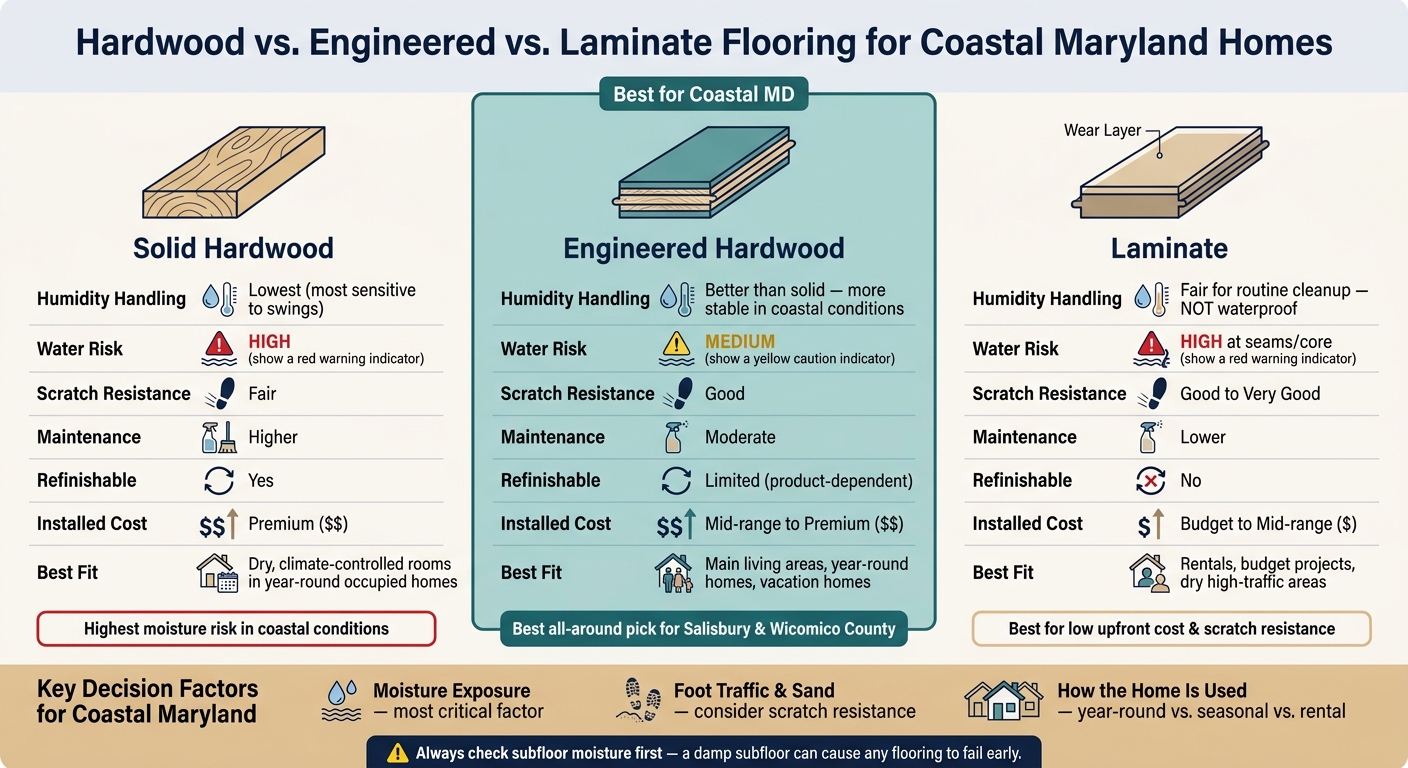
Hardwood vs. Engineered vs. Laminate Flooring for Coastal Maryland Homes
On the Eastern Shore, flooring gets tested hard. Humidity, sand, and stormwater don't take it easy on anything. Add seasonal vacancy and sharp moisture swings, and even good materials can start showing wear early. The big differences come down to three things: how a floor deals with movement, abrasion, and water exposure.
Solid hardwood has that classic look people love, and underfoot, it’s hard to beat. But in Coastal Maryland, moisture is the problem. This material is prone to cupping and gapping, especially when indoor humidity rises and falls through the year.
It tends to do best in tightly conditioned homes that stay occupied and climate-controlled year-round. In homes with frequent humidity swings, the risk goes up. That tradeoff is a big reason many Coastal Maryland homeowners end up looking at engineered wood instead.
Engineered hardwood gives you a real wood surface, but the structure underneath is different. It uses a wood veneer over cross-layered plywood or HDF, which helps limit expansion and contraction.
That makes it better suited to humidity swings and slab installation than solid hardwood. For many Coastal Maryland homes, it lands in the middle: you still get the look of wood, but with fewer movement issues.
For homes where sand is a bigger concern than having real wood, laminate is often the lower-cost option.
Laminate is a synthetic floor built with a durable wear layer and an HDF core. It holds up well against scratches, which matters in sandy, high-traffic homes. That’s especially useful in entryways, hallways, and rental turnovers.
The weak point is water. Standard laminate can swell if moisture gets under the boards. Water-resistant versions handle spills better, but they can still fail after leaks, flooding, or water getting in through open edges.
The biggest gap between these floors shows up with moisture. After that, wear and long-term cost start to separate them.
On the Eastern Shore, that first point matters a lot. Homes here deal with humidity swings, stormwater, and, in some areas, flood risk. If a floor can't handle that setting, the rest of the pros and cons don't matter much.
| Factor | Solid Hardwood | Engineered Hardwood | Laminate |
|---|---|---|---|
| Humidity | Most sensitive to humidity swings | More stable in coastal conditions | Handles routine cleanup well, but is water-resistant, not waterproof |
| Standing water risk | Least forgiving | Better than solid wood, but still needs care | Can be damaged if water gets into the seams |
| Best use | Drier, climate-controlled spaces | Many living areas and rooms with moderate moisture exposure | Dry, busy areas where easy cleanup matters |
| Seasonal homes | Needs the most consistent climate control | More forgiving for homes that sit empty part of the year | Can be a practical low-maintenance option |
| High-moisture rooms | Usually not the first choice | Better fit when installed carefully | Best used only where water exposure is limited |
Bathrooms and kitchens need careful, moisture-aware installation. In vacation homes and rentals, toughness and simple upkeep matter just as much as looks.
That makes room placement the deciding factor. A floor that works great in a living room may be a poor fit for a bath, a kitchen, or a part-time home that sits empty for weeks at a time.
Once you know the moisture risk, the next filter is daily wear. On Delmarva, tracked-in sand is part of life. It doesn't take much to grind away at a floor over time.
| Factor | Solid Hardwood | Engineered Hardwood | Laminate |
|---|---|---|---|
| Scratch and everyday wear | Shows scratches more easily | Good balance of appearance and durability | Often performs well against surface scratches |
| Refinishing | Can be refinished | Limited refinishing, depending on the product | Not refinishable |
| Maintenance | Higher | Moderate | Lower |
| Best fit | Owners who want real wood and plan to maintain it carefully | Homeowners who want a wood look with more stability | Budget-conscious projects, rentals, and easy turnover cleaning |
Solid hardwood gives you the option to refinish, which can help over a long ownership span. Engineered hardwood may allow limited refinishing, but that depends on the product. Laminate is simpler on upkeep, though once it's worn or damaged, refinishing isn't on the table.
For rentals and second homes, lower maintenance can speed turnover after guests or storms.
This is where personal taste starts to matter more. Solid and engineered hardwood feel warmer and more natural underfoot. Laminate can get close on looks, but it doesn't quite land the same feel or sound.
| Factor | Solid Hardwood | Engineered Hardwood | Laminate |
|---|---|---|---|
| Visual realism | Highest | High | Good to very good |
| Feel and sound | Warm and solid | Similar to solid hardwood | Harder and less natural underfoot |
| Installed cost | Premium | Mid-range to premium | Budget to mid-range |
| Overall value | Strong long-term value in well-controlled spaces | Strong all-around value for many coastal homes | Good value when upfront cost and easy upkeep matter most |
Installed cost follows that same pattern. Solid hardwood sits at the top end. Engineered hardwood lands in the middle to upper range. Laminate usually fits projects where upfront cost and easier cleanup carry more weight.
The next question is where each floor makes the most sense in a real Delmarva home.
After looking at moisture, wear, and upkeep, the next step is simple: match the floor to the way the home actually gets used.
For year-round homes in Salisbury and Wicomico County, engineered hardwood is the best all-around pick. You get real wood, better moisture stability, and solid long-term value. Use solid hardwood only in drier rooms with tight climate control. Use laminate when budget and easy upkeep matter most.
How the home is occupied changes the choice. Year-round homes can handle more flooring options, while seasonal homes usually need materials that are easier to clean and bounce back faster after moisture exposure.
For beach houses and rentals, focus on the stuff that causes trouble fast: sand, wet foot traffic, cleanup time, and listing appeal. In that kind of property, engineered hardwood or water-resistant laminate usually fits best.
That puts moisture exposure, sand, and turnover speed at the center of the final decision.
In Coastal Maryland, flooring choice comes down to three things: moisture exposure, foot traffic, and how the home is used through the year.
Solid hardwood is the riskiest option in humidity swings, especially in homes that sit empty during the off-season. If a house isn't occupied for part of the year, steady climate control matters. Without it, boards can cup or warp.
Engineered hardwood is usually the better pick for high-humidity spaces. Laminate can make sense in rentals where scratch resistance and lower upfront cost matter most. That said, edge moisture is still a weak point, so water control can't be ignored.
One more thing trips people up all the time: the floor itself gets the blame, but the problem starts below it. If the subfloor is damp, even a good flooring product can fail early. Check subfloor moisture first, then use the installation method that fits the site conditions before any new flooring goes down. OC Home Services checks subfloor moisture as a standard step on its interior remodeling jobs, before any flooring material gets specified.
One anchor placed — same reasoning as before. This piece is about flooring across the whole home, not a specific room, so interior remodeling is the genuine fit rather than kitchens or bathrooms specifically.
The only way to know for sure is with professional moisture testing. That matters even more in Coastal Maryland, where high humidity is part of daily life.
OC Home Services recommends testing subfloor moisture before installation. It helps reduce the risk of warping, cupping, and mold growth - and it helps protect your flooring investment, whether the property is your home or a rental.
Engineered wood is often the best pick for beach houses that sit empty for part of the year.
Its layered build handles the Eastern Shore’s swings in indoor moisture and humidity better than solid hardwood. When air conditioning isn’t running all the time, solid wood is more likely to warp, cup, or form gaps. Laminate can handle moisture well, but engineered wood looks more like hardwood and tends to hold its value better over time.
Water-resistant laminate can be a smart fit for kitchens and entryways in Coastal Maryland homes - if the product is made for high-moisture areas.
The big detail most people miss is edge sealing. Properly sealed edges help keep sand and salt-heavy moisture from working into the core, which is where problems tend to start. That matters even more near the coast, where damp air and tracked-in grit are part of daily life.
In busy areas where people come in with wet shoes, beach sand, or both, routine upkeep also matters. Sweep often, wipe up water fast, and keep an eye on wear at the seams. It's not glamorous. It does help the floor hold up better over time.
