
If your kitchen is on the Eastern Shore, quartz is usually the safest countertop choice for any kitchen remodeling project. It is non-porous, does not need sealing, and holds up better than wood, laminate, and concrete when humidity stays high for months.
Your main takeaways are simple:
Humidity on Delmarva does not just affect looks. It hits seams, sealers, edges, and wood movement. That is why the best countertop is usually the one that needs the least moisture-related care.
Quick comparison
| Material | Moisture | Seams | Upkeep | Best fit |
|---|---|---|---|---|
| Quartz | Very strong | Tight, visible | Low | Full-time homes, rentals |
| Granite | Good if sealed | Visible | Medium | Homes where owners keep up with sealing |
| Solid surface | Very strong | Very low-profile joints | Low | Vacation homes, sink-heavy kitchens |
| Butcher block | Weak | Can gap or move | High | Dry prep areas |
| Laminate | Weak at edges and seams | Higher risk | Low | Budget kitchens |
| Concrete | Fair if sealed | Can form hairline cracks | High | Custom-style kitchens |
The rest of the article breaks each material down by moisture resistance, seam performance, upkeep, and fit for full-time versus vacation homes.
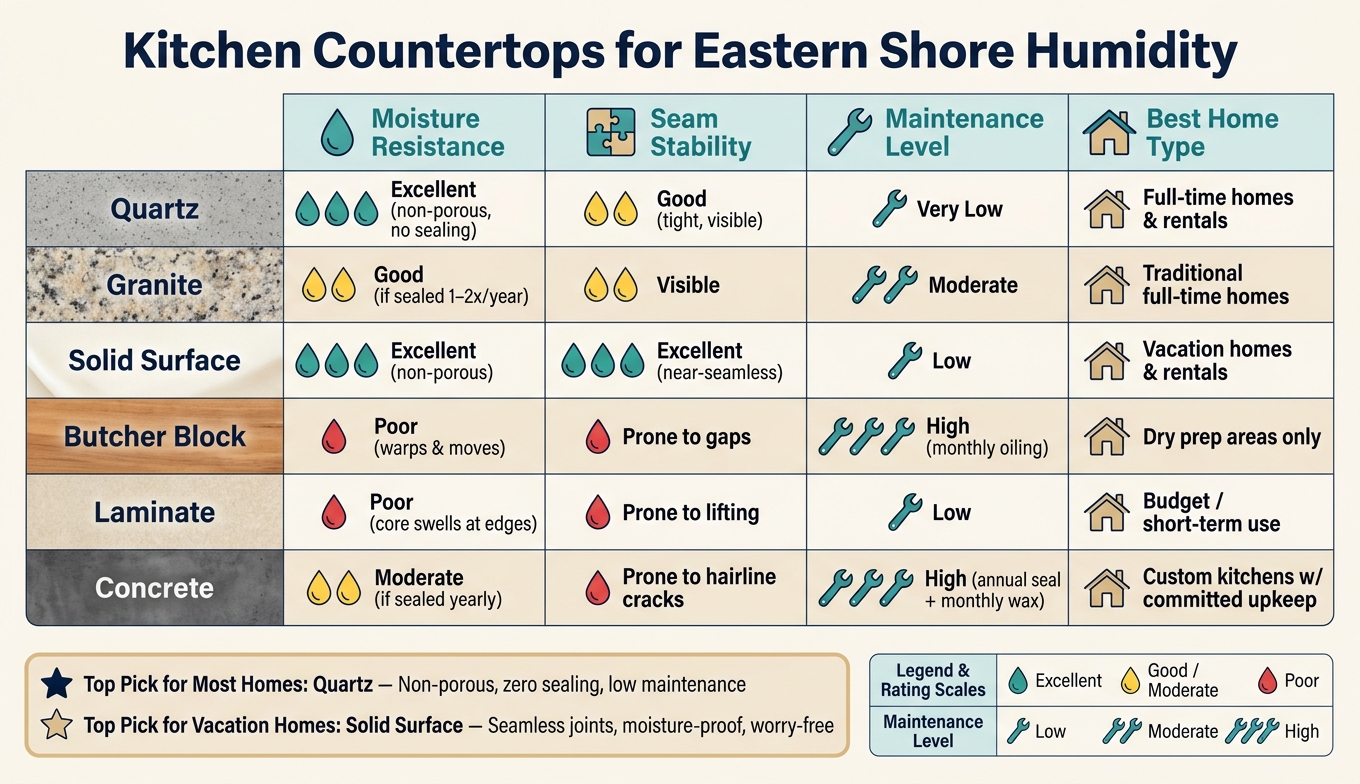
Kitchen Countertops for Humid Climates: Side-by-Side Comparison
Quartz is one of the best picks for humid coastal kitchens. It’s an engineered stone - roughly 90% ground quartz crystals bound together with resins and pigments - and its non-porous surface resists moisture and never needs sealing.
Quartz doesn’t absorb moisture, so it resists mold, mildew, and bacteria. That matters in vacation homes that sit closed up for weeks at a time. Less moisture getting in means fewer odors and less mildew buildup, with less work between visits.
Quartz tends to move less than many natural stones because its resin-bound structure stays more stable through seasonal humidity swings. Seams will still be visible, but pattern matching is usually more predictable than with natural stone because quartz is manufactured for consistency.
Upkeep is simple: use mild dish soap and water. Skip abrasive pads, bleach, and harsh cleaners, and use trivets for hot pans. The resin can scorch above about 150°F.
Quartz holds up well indoors, but UV exposure can fade or yellow the resin in bright kitchens. In sunny rooms, a matte or honed finish can cut glare and make fingerprints less obvious.
If you like the look of natural stone more than an engineered material, granite is the next comparison.
Granite is a natural stone, and it handles heat with no drama. The catch on the Eastern Shore is moisture. Its pores can soak in humidity and spills, so sealing is part of the deal if you want the surface to stay protected.
On the Eastern Shore, humidity is where granite gets tested. In coastal kitchens, unsealed granite can absorb spills, which may lead to stains or bacterial growth. That risk gets worse in homes that sit closed up for weeks at a time. Plan to reseal it once or twice a year.
A simple check works well: put a few drops of water on the counter. If the water beads, the seal is still doing its job. If it soaks in within 15 minutes, it's time to reseal.
Day-to-day cleaning is easy. Use pH-neutral soap and water. Skip vinegar, bleach, and other acidic cleaners, since they can wear down the sealant and leave the stone open to moisture and stains.
If your faucet area tends to show water spots, a honed or leathered finish does a better job of hiding mineral marks than a high-polish surface. For vacation homes, it's smart to check the seal before leaving the house shut for weeks.
With regular sealing, granite can last for decades. It also stands up to UV exposure better than quartz in bright kitchens.
"Natural stones like granite are more UV-resistant and handle direct sun well - something to consider if your kitchen has big south-facing windows." - Christopher Sexton, 302 Renovations
If you'd rather deal with less sealing, solid surface is the next option.
If granite feels like too much of a sealing chore, solid surface is the easier pick for homes on the Eastern Shore. It is non-porous, low-maintenance, and moisture-resistant.
Unlike laminate, solid surface has no absorbent core. That means it will not swell, delaminate, or need sealing.
Its biggest selling point is the seam work. Seams are nearly invisible, and sinks are often built right into the counter. No gaps, no little crevices, no easy place for moisture to sit and mildew to grow. That's a big plus in homes that stay closed up for stretches at a time.
Daily care is about as simple as it gets: wipe it down with mild soap and water. If light scratches start to show over the years, they can usually be sanded out without bringing in a pro.
Heat is the main downside. Use trivets, because direct heat can melt or discolor the surface. Aside from that, it holds up well through Delmarva's seasonal humidity and temperature swings, and it works for both full-time homes and vacation properties.
If you want a warmer look and don't mind more upkeep, butcher block is next.
Butcher block adds warmth and character. In an Eastern Shore kitchen, though, that look comes with work.
Wood and humidity don't get along, and Delmarva's swings in moisture put butcher block under steady stress. In a coastal home, it's not just a design pick. It's a maintenance commitment. That means grain direction and joint design matter just as much as the species of wood.
Wood moves with humidity. It swells, shrinks, and over time that movement can lead to warping, cracking, and finish failure. Flat-grain butcher block tends to fail first. Edge-grain construction and laminated strips hold up better than flat-grain slabs.
The space within 6 inches of a sink is where problems show up most often. Standing water can blacken the wood, make it swell, and break down glue joints until the top starts to delaminate.
The simple fix is to use butcher block on islands or prep areas, not on sink runs. If it goes near a dishwasher, seal the end grain and the underside, and use slotted fasteners instead of glue. Around butcher block, moisture is the enemy, so sealing and cleaning matter more than they do with any nonporous surface.
This is not a set-it-and-forget-it countertop.
Butcher block needs regular care:
For cleaning, use white vinegar or 3% hydrogen peroxide when mold is a concern, and skip bleach. Winter is also a good time to check it more often. If the surface looks pale or dry, it needs oil.
Here's the upside: butcher block is repairable. Scratches, water rings, and scorch marks can be sanded out, and a standard 1.5-inch-thick slab can be refinished 6 to 8 times over its lifespan. With proper care, butcher block can last 20+ years in a full-time home.
Vacation properties are a different story. A house that sits empty through humid summers and dry winters is a tougher place for wood. Butcher block works best for owners who stay on top of maintenance. Ignore it for long enough, and it tends to make you pay for it.
Laminate trades price for durability, especially around seams and edges.
After butcher block and all the upkeep that comes with it, laminate sits on the other end of the spectrum. It’s easy to live with day to day - until water gets under the surface. That’s the trade-off.
Laminate is the lowest-cost option in this group, but price isn’t the main issue. Moisture is.
The top layer handles normal spills well enough. The trouble starts when water reaches the particleboard or MDF core through a seam, chipped spot, or exposed edge. Once that happens, the core swells, and in most cases the countertop has to be replaced.
In other words, the surface usually isn’t what fails. The weak spot is where water finds a way in.
Seams are the biggest risk in any laminate installation. Unlike quartz or solid surface, laminate seams are visible, and over time they can hold moisture and grime. In a humid place like the Eastern Shore, that matters more than people think.
Sink placement and edge treatment do a lot of the heavy lifting here. A drop-in sink is often the safer pick because it helps keep water away from exposed substrate edges. Spills near seams need to be wiped up right away, and the backsplash joint needs to be sealed tight during installation.
Choose high-pressure laminate instead of builder-grade laminate if you can. It gives you better density and better resistance to dings and wear.
Maintenance is simple: soap and water, no sealing, no special routine. Just skip abrasive scrubbers.
Heat is a different story. Laminate can scorch almost right away from a hot pan, so cutting boards and trivets aren’t optional if you want it to last. Burns usually can’t be fixed, which means replacement is often the only path.
Laminate usually lasts about 10–20 years in a residential kitchen. It also doesn’t give you much room for repair. If it burns, swells from moisture, or gets deeply scratched, replacement is usually the only answer.
That makes laminate a fit for low-risk, budget-focused kitchens. But in vacation homes that may sit empty during humid summers, hidden seam damage becomes a bigger concern. If water gets in and no one notices for weeks, things can go south fast.
If you want a heavier, more custom surface and don’t mind a more involved install, concrete is next.
Concrete can be poured into custom shapes, which is a big part of the appeal. On Delmarva, though, the bigger issue isn't style. It's maintenance. If sealing and upkeep slip, concrete tends to show it fast.
Concrete is porous, so it needs a penetrating sealer and wax to help resist stains and moisture. Near the coast, salt air adds one more problem. If the surface is unsealed or the upkeep falls behind, concrete can turn dull or start to pit over time.
A simple test helps here: reseal when water stops beading on the surface. Once moisture starts getting in, the material becomes much harder to keep looking clean.
Concrete is a high-upkeep countertop option. It often needs resealing every year, and busy surfaces may need waxing once a month. For cleaning, use pH-neutral soap and skip bleach or abrasive products. If the sealer has worn down, acidic spills like lemon juice or vinegar should be wiped up right away.
That last point matters more than it may seem. In a full-time home, someone usually catches a spill. In a vacation home, it might sit there for days. That's where concrete becomes a tougher sell.
Concrete countertops usually last about 20 to 30 years. Hairline cracks are normal. In high humidity, the material can move more, so installers should leave expansion gaps.
Weight matters too. Concrete weighs about 15 to 20 lbs. per sq. ft., which means some cabinets may need reinforcement before installation.
Concrete makes sense for homeowners who want a custom look and don't mind steady upkeep. On Delmarva, that's the tradeoff in plain English.
Here’s the quick comparison.
| Material | Moisture Resistance | Seam Stability | Maintenance | Best Use |
|---|---|---|---|---|
| Quartz | Excellent (non-porous) | Good (visible but tight) | Very low | Full-time homes and rentals |
| Granite | Good (if sealed) | Visible | Moderate (reseal 1–2x/year) | Traditional full-time homes |
| Solid Surface | Excellent | Excellent (seamless) | Low | Vacation rentals; integrated sinks |
| Butcher Block | Poor (warps, moves) | Prone to gaps | High (monthly oiling) | Dry prep areas only |
| Laminate | Poor (core swells) | Prone to lifting | Low | Budget builds; short-term use |
| Concrete | Moderate (if sealed) | Prone to hairline cracks | High (annual seal, monthly wax) | Custom looks with committed upkeep |
The pattern is pretty clear. Full-time homes can lean harder into long-term wear, while vacation homes need materials that handle humidity and neglect without turning into a maintenance project.
For full-time homes, quartz is the best pick. It’s non-porous, easy to live with, and built for daily use. Granite is a solid second choice if you’re willing to reseal it 1–2 times per year.
For vacation properties, quartz and solid surface make the most sense. Both resist moisture well, and both stay easy to manage when the kitchen sits unused for weeks at a time.
In coastal kitchens, seam placement and cabinet support matter just as much as the countertop itself.
On the Eastern Shore, start with moisture resistance and seam stability. Then look at upkeep, heat tolerance, and budget. That shifts the choice away from looks alone and puts the focus where it belongs: how your kitchen gets used every day.
For most Salisbury-area kitchens, quartz is the best all-around pick. It's non-porous, handles humidity well, and never needs sealing. One catch: set down trivets or hot pads. A hot pan can damage the resin.
If quartz doesn't fit the budget or the look you want, the next picks come down to how much maintenance you're okay with. Granite works well for homeowners who don't mind regular resealing and want better heat resistance. Solid surface fits homes that need low-upkeep, seamless, moisture-resistant counters. OC Home Services walks Eastern Shore homeowners through these tradeoffs on every kitchen remodeling project, since the right countertop depends on how a specific family cooks and cleans.
For most Eastern Shore remodels, quartz stays out front, with granite and solid surface close behind for homeowners who want a different set of tradeoffs.
Quartz is usually the better pick when you want a non-porous countertop that stands up well to stains and needs very little upkeep in humid spaces. It works especially well in busy kitchens where spills, splashes, and daily wear are part of the routine. The trade-off is simple: quartz handles moisture well, but it doesn't like high heat or long stretches of UV exposure.
Solid surface gives you a smoother, more uniform look and is easier to fix if it gets scratched. That said, it's a softer material, so it marks up more easily and can take damage from heat and daily abrasion. Pick it if a seamless appearance and easier repairs matter more than maximum hardness.
Near a sink, non-porous materials like quartz or porcelain are usually the best pick. They handle moisture well and don't need sealing.
Quartz is a go-to for busy households because it resists stains and takes very little upkeep. That matters around a sink, where water, soap, and toothpaste tend to end up everywhere.
If you choose granite, stay on top of sealing around the sink area. With butcher block, be extra careful. Standing water can lead to swelling, cracking, or seam failure. It's also smart to avoid placing seams right at the sink cutout.
Quartz is often the best pick if you want almost no upkeep. Its non-porous, engineered surface needs very little care, which makes it a smart fit for a clean, low-stress kitchen when you're away. It’s not the right material for outdoor areas or rooms that get harsh direct sunlight.
For outdoor kitchens or bright, sun-soaked spaces, granite or porcelain make more sense. Granite holds up well but does need sealing from time to time. Porcelain is tough, resists moisture, and handles shifting conditions well.
