
If the gaps around your door are even, the slab or hardware is often the problem. If the gaps are uneven, the opening likely moved, and replacing only the door may not fix it.
Before you buy a new interior door, check five things:
In many homes, a slab-only replacement works when the jamb is straight, solid, and square. But if you find soft wood, diagonal gap problems, drywall cracks, or signs of water, the fix may involve the jamb, trim, or wall too. That usually means more labor, more finish work, and a higher cost than a simple slab swap.
On Maryland's Eastern Shore, high humidity and past storm moisture can turn a small door problem into a frame problem. A slab-only job is usually the lower-cost path. A jamb reset or full prehung replacement is more common when the opening is out of square or the bottom of the jamb has rot, and it's the kind of fix that often surfaces during broader interior remodeling work in older coastal homes.
Quick Comparison
| Issue found | What it often means | Common fix |
|---|---|---|
| Even gaps, loose hinges, latch slightly off | Slab or hardware issue | Slab repair or slab-only replacement |
| Door swollen at bottom, jamb still firm | Door slab moisture damage | Replace slab and seal edges |
| Wide gap at one corner, tight gap at another | Opening out of square | Re-shim jamb or replace full unit |
| Soft jamb near floor, stains, crumbling drywall | Moisture damage past the door | Trim removal, repair, then new door |
| Strike adjustment failed and door still won’t latch | Jamb likely shifted | Jamb work or prehung replacement |
The short answer: match the repair to the opening, not just the door.
Before you order anything, check the gap between the door and the jamb on all three sides. That one step helps you figure out whether you're dealing with a door slab problem or something deeper in the frame, jamb, or wall. That matters, because ordering the wrong part wastes time and money.
Open and close the door a few times. Tighten the hinge screws. Test the latch. Then look closely at the bottom edge of the door for swelling. If the screws just spin and never bite, the screw holes are stripped. If the latch doesn't meet the strike plate cleanly, note whether the bolt is just off-center or not reaching it at all. Soft or swollen wood at the bottom usually points to moisture damage, not normal wear. These checks help sort out a door problem from a framing problem.
If the gaps are even but the door still sticks or won't latch, the slab or hardware is often the issue. Stripped hinge screw holes that won't hold usually mean a hardware repair, not a framing problem. Swelling at the very bottom of the door can also point to a slab issue, especially if the jamb and floor still feel solid.
Uneven gaps are the clearest sign that the opening itself has shifted. If the gap is wide at one corner and tight at the opposite corner, the frame is out of square. Check the casing around the door too. If you see gaps between the casing and the wall, or cracks in the drywall near the upper corners, the surrounding structure has moved.
Press on the jamb near floor level. If the wood feels soft or spongy, moisture damage likely goes past the slab. And if you've already adjusted the hinges and moved the strike plate but the door still won't latch the way it should, the jamb has likely shifted.
| What You're Checking | Slab/Hardware Issue | Jamb/Frame Issue |
|---|---|---|
| Gap around door | Even on all sides | Wide at one corner, tight at another |
| Hinge screws | Strip out, won't tighten | Solid, but door still rubs |
| Casing and drywall | No cracks or gaps | Casing pulling away, corner cracks |
| Jamb at floor level | Firm wood | Soft or spongy to the touch |
| Latch behavior | Misses strike after hinge fix | Still misses after hinge and strike adjustment |
If the opening is square and the weak spot is the hardware, a slab-only replacement may be enough. If these checks show the opening is sound, the next step is figuring out whether a slab-only replacement will fix the problem.
If the jamb is straight, solid, and lined up, a slab-only replacement can fix the problem.
When the jamb is straight and the opening is sound, replacing only the slab is often enough. For minor sticking or sagging, a new slab can take care of the issue without tearing into the full frame. Seal the new slab well, especially along the bottom edge, to help limit swelling in Eastern Shore humidity.
If the frame is still in good shape, this can also be a smart time to move from a hollow-core door to a solid-core slab. That switch can help with sound control and wear over time, especially in humid coastal conditions. Solid-core slabs weigh more, so hinge strength and hardware capacity need to be checked before ordering.
This route makes the most sense when the opening is sound and the goal is better function, longer wear, or a cleaner look.
Once the frame stays in place, the next call is how the finished opening will look. In older Eastern Shore homes, matching aged trim or discontinued casing profiles can mean paint touch-ups or a change in hardware finish.
Match the hardware finish to the new slab so the opening looks intentional.
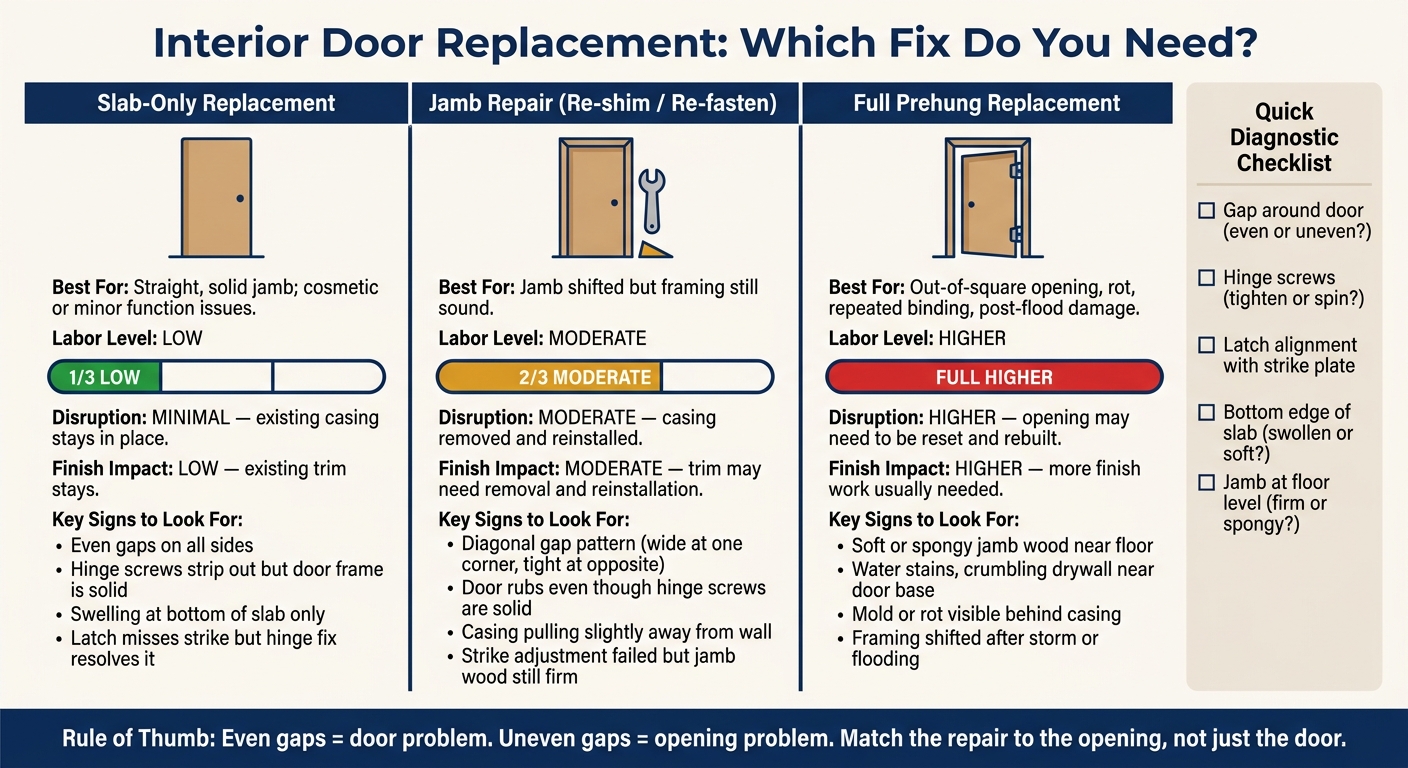
Interior Door Problem: Slab vs. Jamb vs. Full Replacement Guide
Sometimes the door isn’t the main problem. The opening is.
When the gap tests show the opening is off, not the slab, the repair can change in a hurry. What looked like a simple door swap can turn into jamb work, trim removal, or even wall repair.
One of the clearest signs of an out-of-square opening is this: the door is tight at one top corner and loose at the opposite bottom corner. That diagonal gap pattern usually means the jamb is twisted or the framing behind the wall has settled. It’s usually not a bad slab.
Cutting the slab might make the door work for now. It won’t fix the root issue.
What happens next depends on how far the opening has moved. If the jamb sides are still fastened to sound framing, a contractor can remove the casing, re-shim the jamb, and secure it back plumb. If the framing itself shifted after storms or flooding, the frame may need to be reset as part of a full prehung replacement.
Soft wood at the base of a door jamb is a strong sign that the issue goes deeper than the slab. In Delmarva homes, flood history and high humidity can damage the bottom of the jamb and the drywall nearby.
Water stains, crumbling drywall, or any soft spot when you press on the jamb near the floor are signs the trim should come off before any door choice gets made. If mold or rot shows up behind the casing, the opening may need remediation and repair before a new door assembly goes in.
A contractor who handles carpentry and water damage repairs can figure out whether the problem stops at the door or ties back to hidden wall damage.
That choice affects labor, finish work, and budget.
| Factor | Slab-Only Replacement | Jamb Repair (Re-shim/Re-fasten) | Full Prehung Replacement |
|---|---|---|---|
| Best for | Straight, solid jamb; cosmetic or minor function issues | Jamb shifted but framing still sound | Out-of-square opening, rot, repeated binding, post-flood damage |
| Labor | Low | Moderate | Higher |
| Disruption | Minimal; existing casing typically stays in place | Moderate; casing is removed and reinstalled | Higher; the opening may need to be reset and rebuilt |
| Finish-matching impact | Low; existing trim stays | Moderate; trim may need to be removed and reinstalled | Higher; more finish work is usually needed |
Once you know what's actually wrong, pricing gets a lot easier.
The next step is figuring out how far the repair goes. Sometimes the issue is limited to the door slab. Sometimes it runs into the jamb, casing, or even the wall around the opening. That difference drives the job scope.
A slab-only replacement usually keeps labor and finish work fairly light. But older homes can hide plaster, drywall, or framing trouble behind the casing, and that adds labor fast. The door itself can add work too, especially when the replacement needs hinge tweaks, latch prep, trimming, or new hardware. Then the small add-ons start stacking up: trim removal, patching, priming, painting. At that point, the final cost can move past the first quote.
Hidden damage is where budgets usually shift. A jamb can look fine on the surface and still have soft wood at the bottom from moisture or old storm damage. When that shows up mid-job, the repair plan changes right there on site.
That's why pricing should start with a hands-on inspection, not just a list of parts. A door doesn't work by itself. The slab, hinges, jamb, and the wall around it all affect each other. Checking those pieces before materials are ordered helps homeowners avoid buying the wrong replacement.
In Delmarva homes, storm or water damage can turn what looks like a simple door swap into a much larger repair. A licensed contractor can spot those signs early and price the work the right way. In Maryland, paid home improvement contractors must hold an active MHIC license, and homeowners should verify that license in the state database.
If the frame is straight, the jamb is solid, and the opening is square, replacing only the slab and hardware is often enough.
But if the opening is out of square, the jamb feels soft, or there's any sign of past moisture, a larger repair usually makes more sense. A door that works smoothly on day one but starts binding again within a year because the root problem was skipped ends up costing more than fixing it right the first time. OC Home Services checks the opening itself before quoting a fix, since that step is what separates a slab swap from a job that turns into full interior remodeling.
Match the repair to the opening, not just the door.
Yes - sometimes.
Replacing only the door slab and hardware can work when the existing frame is plumb, square, and still in good shape. In that case, a slab swap is often the simpler path.
But if you’re seeing uneven gaps, a door that sticks, or signs of structural movement, the problem usually goes beyond the slab. At that point, the full door unit - including the frame - often needs to be replaced so the door fits and works the way it should.
A professional walkthrough can tell you pretty fast whether a simple slab swap makes sense or if a full replacement is the better call.
Check the surrounding frame, jamb, and trim for rot, swelling, soft spots, crumbling, or discoloration. If the door jamb feels spongy or the trim base is breaking down, moisture has likely spread beyond the door itself.
Sticking that won’t go away or gaps that look uneven can point to warped or shifted jambs from water exposure. In that case, replacing only the slab probably won’t solve it.
A prehung door makes more sense when the current frame is worn out, out of square, or too far gone for a simple fix. A slab replacement is the better fit when the jambs are still in good shape and lined up the way they should be.
Go with a prehung unit if you notice uneven gaps caused by frame movement, heavy moisture damage on the jambs, or if you're changing the door size.
