
If you have laminate countertops, a drop-in sink is usually the right fit. If you have quartz, granite, quartzite, or solid-surface counters, an undermount sink is often the better match.
Your sink choice affects installation cost, cleanup, countertop fit, and how well the area holds up in Eastern Shore humidity, salt air, and hard water. A bad match can lead to failed seals, cabinet damage, and, in coastal conditions, cabinet bases wearing out in as little as 5–7 years.
Before replacing a sink, you should check:
A drop-in sink sits on top of the counter and is usually the simpler choice for a direct replacement. An undermount sink mounts below the counter, gives you a cleaner look, and makes wipe-downs easier, but it needs the right countertop and stronger support. For sink swaps that turn into a full countertop or cabinet project, the kitchen remodeling team can assess which mount type fits the existing layout before any demolition starts.
Quick Comparison
| Factor | Drop-In Sink | Undermount Sink |
|---|---|---|
| Best countertop match | Laminate, wood, tile, many existing counters | Quartz, granite, quartzite, solid surface |
| Install difficulty | Lower | Higher |
| Cleanup | Rim can trap water and crumbs | Counter wipes straight into sink |
| Seal points to watch | Rim caulk line | Silicone seam under counter edge |
| Support needs | Lower | Higher, especially for heavier sinks |
| Best fit for | Fast replacements, older kitchens, rentals | Remodels, stone counters, cleaner work surfaces |
| Typical cost | Lower install cost | Higher install cost |
| Coastal concern | Caulk and rim need regular cleaning | Seal and support need periodic checks |
For most homeowners, the short answer is simple: match the sink to the countertop first, then think about upkeep and labor cost. That is what this comparison breaks down.
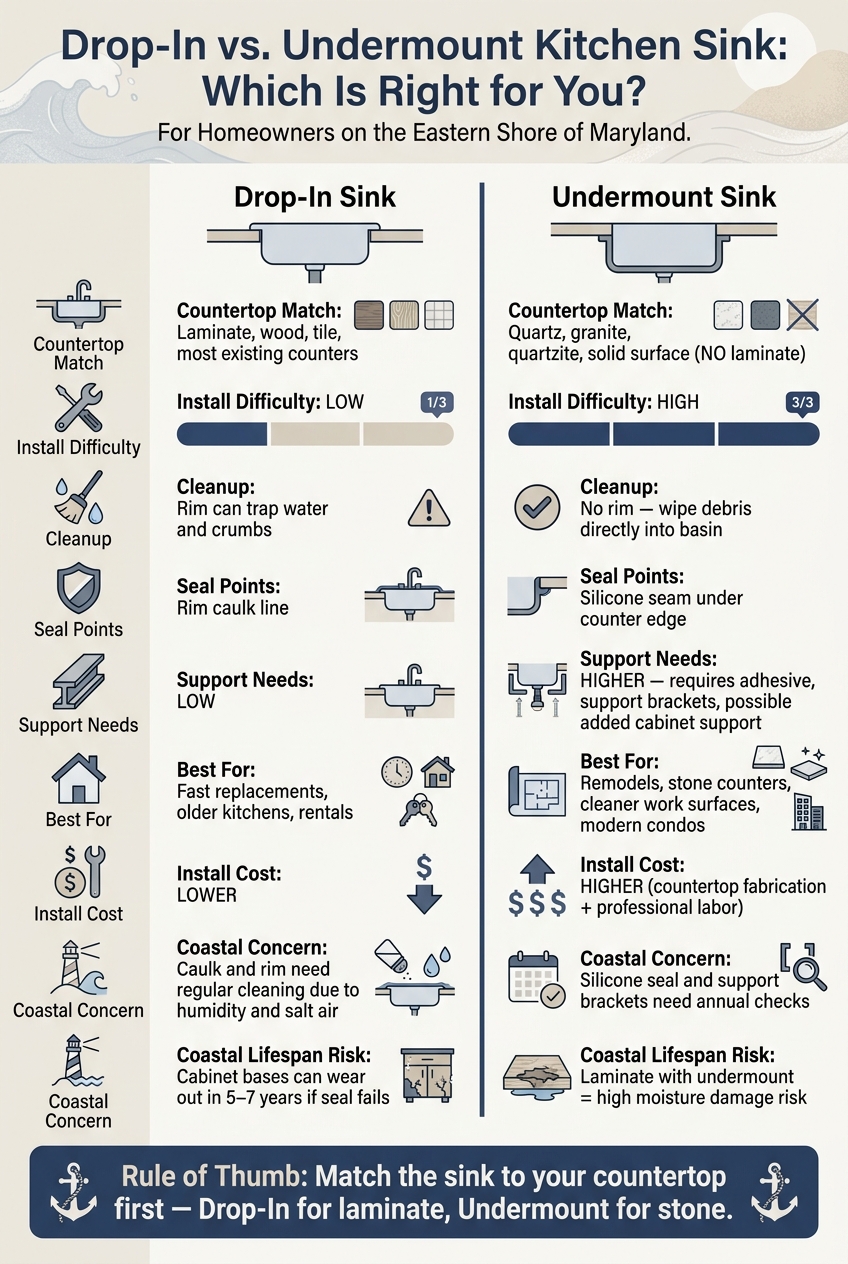
Drop-In vs. Undermount Kitchen Sink: Which Is Right for You?
Drop-in sinks make sense when you want to swap the sink without tearing into the countertop. The visible rim hides the cutout and holds the sink in place from above, then the sink gets secured underneath with clamps and silicone caulk.
This style works especially well with laminate. The rim covers the cut edge and helps protect the substrate, which is why drop-in sinks are such a good match for older Eastern Shore kitchens and rental properties where the counters are staying put. The cutout needs to be a bit smaller than the sink’s outer edge so the rim can sit on top of the counter.
| Feature | Drop-In Sink |
|---|---|
| Installation Difficulty | Low; often DIY-friendly |
| Countertop Compatibility | Laminate, tile, butcher block, solid surface, stone |
| Cleaning | Rim and caulk line require regular attention |
| Durability | High; weight is supported by the countertop rim |
The rim is the part that needs the most care. On the Shore, moisture and hard-water residue tend to build up along the rim and caulk line, so regular cleaning matters. A quick wipe goes a long way. It also helps to check the caulk seal now and then and re-caulk with silicone if needed to keep water from slipping under the edge.
With stainless steel, a simple routine works best:
Skip steel wool in particular. It can scratch stainless steel and leave behind residue that may rust.
If you want a smoother work surface and already have stone countertops, undermount sinks come with a different set of tradeoffs.
When the countertop is stone or solid surface, an undermount sink is usually the cleaner pick. It attaches to the underside of the counter instead of sitting on top. That means no rim above the work surface, so crumbs and spills wipe straight into the basin instead of catching at the edge. Cleanup is simpler and faster, which helps in kitchens where people cook often or need to clean up in a hurry.
The countertop material is the deal-breaker here. Since the cutout edge stays exposed, the counter has to be solid and able to handle moisture at that opening. Quartz, granite, quartzite, and solid-surface materials all fit. Standard laminate does not, because the exposed particleboard or MDF core at the cutout is highly prone to moisture damage and can swell or rot.
Installation is more involved than a drop-in sink. It needs a finished cutout, silicone adhesive, and support brackets fastened to the cabinet base. Larger stainless steel or fireclay sinks may also need added cabinet support.
| Feature | Undermount Sink |
|---|---|
| Required Countertop Materials | Quartz, Granite, Quartzite, Solid Surface (no laminate) |
| Installation Complexity | High; requires finished cutout, adhesive, and support brackets |
| Cleaning Ease | High; no rim allows debris to wipe directly into the basin |
| Maintenance Points | Monitor silicone seal integrity and support brackets over time |
That smooth counter-to-sink transition makes daily cleanup easier. In rentals and busy kitchens, a surface you can wipe down in one pass saves time and hassle.
The main thing to watch is the silicone seal between the sink edge and the stone. That bead of sealant keeps water from getting into the cabinet. Check it once a year. If it starts to peel, crack, or show dark spots or mold, reseal it before moisture reaches the cabinet. This is even more important in seasonal rentals and other high-use kitchens.
Use this quick comparison to match the sink to your countertop and the amount of upkeep you're willing to take on.
| Factor | Drop-In (Top-Mount) | Undermount |
|---|---|---|
| Installation Difficulty | Lower; generally DIY-friendly with silicone and mounting clamps | Higher; typically needs professional installation and support clips |
| Compatible Countertops | Laminate, wood, and most conventional surfaces | Solid-surface countertops such as quartz, granite, or quartzite |
| Care | Rim can catch crumbs and moisture; periodic re-caulking helps prevent seepage | No visible rim; wipe directly into the basin; check the silicone seam for mold or separation |
| Support Needs | Lower; the rim helps distribute weight across the countertop surface | Moderate; relies on adhesive and support clips, and heavier models may need added cabinet support |
| Best Use Case | Older kitchens, laminate updates, and fast replacements | Stone-countertop remodels and modern condos |
Warranty coverage often depends on pairing the sink type with the right countertop material.
In most Eastern Shore kitchens, the decision comes down to the counter you have now or the one you're planning to install.
If you're working with laminate counters or doing a fast sink swap, a drop-in is usually the easiest path. It fits the setup, keeps labor simpler, and avoids turning a basic replacement into a bigger project.
If you're upgrading to quartz or granite, an undermount usually makes more sense. It gives the sink-to-counter line a cleaner finish and works with the kind of solid-surface tops that can handle that install style. For rental or vacation properties, drop-in is often the lower-disruption choice when the counters are staying in place.
Drop-in sinks usually cost less to install because the work is more straightforward. Undermount sinks cost more because they often need countertop fabrication, support hardware, and professional labor.
Price matters, but on the Eastern Shore, coastal conditions often make the bigger call.
Humidity and salt air can wear down sink finishes, hardware, and cabinet bases faster than many homeowners expect. Use the wrong material or the wrong install method, and cabinet bases can be cut down to 5–7 years of life. In seasonal homes and rentals heading into Memorial Day, that detail hits harder. A watertight seal around the sink isn't just nice to have - it helps prevent the kind of moisture damage that turns into a much bigger repair.
Material match matters, too. On the coast, drop-in sinks still make the most sense for laminate countertops. Undermount sinks work with quartz or granite, but only if the countertop and cabinet have enough support to handle the weight. In some coastal installs, corrosion-resistant or marine-grade hardware also makes sense because of salt air exposure.
Stainless steel has its own coastal issue. In beach-area kitchens, salt-air chlorides can pit the surface if residue sits too long. For rentals with frequent guest turnover, 16-gauge stainless steel is worth a look because it offers more durability and better corrosion resistance.
Any Maryland work that moves plumbing lines should be handled by an MHIC-licensed contractor.
Once the job goes past a simple swap, bring in a pro.
Before replacing a sink, a contractor can check the countertop material, cutout size, cabinet support, and seal needs. That step can save a lot of guesswork, especially in beach communities like Ocean City or Salisbury, where kitchens often see heavy seasonal use. OC Home Services handles these pre-install checks as part of its kitchen remodeling work across the Eastern Shore. If the home needs to be ready for summer traffic, it's smart to plan the project before Memorial Day.
Generally, no.
A drop-in sink covers a rough, unfinished cutout. An undermount sink needs the opposite: a finished, polished edge cut to exact dimensions.
That means a retrofit usually isn't a simple swap. In most cases, the countertop has to be professionally re-cut. That can get expensive, and with materials like stone or quartz, there's a high chance the countertop cracks during the process.
Check that the base cabinet can handle the sink’s full load - not just the basin itself, but the water and any add-ons too. Many undermount sinks rely on the countertop for support, but heavier models may need a custom support kit or a reinforced cabinet base.
Then measure the cabinet interior. You need enough room for the sink bowl, plumbing, and mounting hardware. If you’re swapping out an old sink, compare your cabinet dimensions with the new sink’s specs before you buy anything.
Both can work in a beach house rental, but there’s a trade-off either way.
Undermount sinks look cleaner and make day-to-day cleanup easier. You can wipe sand, hair, and other debris straight into the basin, which matters in a high-turnover rental where fast cleaning saves time.
Drop-in sinks usually cost less to install or swap out. That’s the upside. The downside is the rim can hold moisture and grime, so in a damp, salty beach climate, they often need more upkeep.
