
Your siding may need replacement when damage affects several walls or repairs keep failing - not just because it’s old. One damaged panel with sound backing may only need repair. Cracks, warped panels, recurring dampness, or rot call for an inspection of the siding and the wall behind it.
Around Ocean City and Rehoboth Beach, salt exposure, moisture, and storms make water protection a priority. After a storm, check from the ground for loose panels, open seams, and exposed underlayment. Don’t climb or pull panels loose.
Before work starts, ask for <u>proof of state licensing and a written scope</u> covering siding, flashing, hidden wall damage, and approval for added repairs. For occupied homes or rentals, request photo updates and a schedule that fits your calendar.
Inspect each wall from the ground. Photograph damage by wall, panel row, corner, and window so a contractor can tell surface damage from a larger failure. Do not climb or pry panels loose to look underneath. When damage keeps appearing in the same places, contractors look beyond the surface to find the cause.
Cracking, bowing, or swelling across several walls points to a larger failure - not just an isolated damaged panel.
Look for separated seams, detached edges, and missing panels. Contractors check fasteners, seams, trim, and corners to determine whether repairs will hold or the siding needs replacement. If repairs keep failing after storms, the problem may be structural rather than cosmetic.
Once a storm passes and conditions are safe, check for punctures, exposed underlayment, and damage around windows. These signs help show whether the siding still protects the wall. In Delmarva, make these checks after nor'easters or tropical storms.
Ask a licensed contractor for a prompt assessment if detached panels or open seams could let rain in. Open seams and punctures can allow water to reach the wall assembly.
Damage that keeps coming back gives contractors a reason to look behind the panels. Rot points to water getting in - not just siding getting old. New panels won’t solve the problem unless the water source gets found and fixed.
Watch for soft spots, stains that reappear, and areas that stay damp. These signs usually point to moisture behind the siding.
Contractors may need to remove a small section of siding to check the flashing and wall sheathing behind it. Flashing directs water away from joints, but hidden moisture damage can reach beyond the sheathing and into the framing.
Ask for a detailed written estimate that spells out any flashing, sheathing, or framing repairs - not just which panels need replacing.
When moisture reaches these parts of the wall, contractors assess whether repair is still practical. What they find helps determine whether the work stays a repair or calls for full replacement.
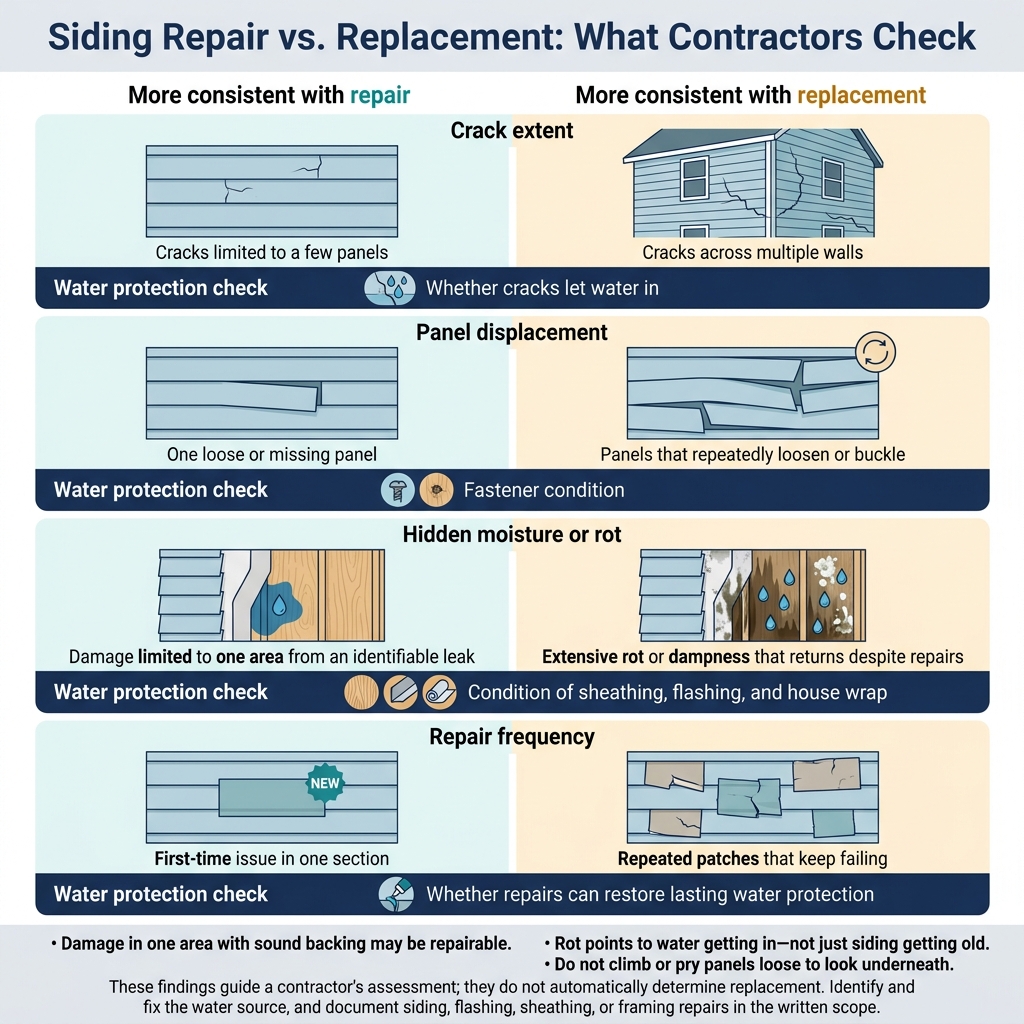
Siding Repair vs. Replacement: What Contractors Check
Once surface damage and signs of moisture are clear, contractors check whether a repair will hold - and whether the wall can still keep water out. Damage in one area with sound backing may be repairable. Deterioration across larger areas or repeated failures may call for replacement if the wall no longer blocks water.
| Inspection condition | More consistent with repair | More consistent with replacement | Additional water protection check |
|---|---|---|---|
| Crack extent | Cracks limited to a few panels | Cracks across multiple walls | Whether cracks let water in |
| Panel displacement | One loose or missing panel | Panels that repeatedly loosen or buckle | Fastener condition |
| Hidden moisture or rot | Damage limited to one area from an identifiable leak | Extensive rot or dampness that returns despite repairs | Condition of sheathing, flashing, and house wrap |
| Repair frequency | First-time issue in one section | Repeated patches that keep failing | Whether repairs can restore lasting water protection |
If repairs make sense, the written scope should spell out what gets opened, fixed, and replaced. That includes affected walls, likely water-entry points, hidden damage, and proposed work on siding, flashing, trim, and the wall itself. Ask how the contractor will document any additional damage and get your approval before expanding the work.
Get that scope and proof of state licensing before work starts.
For occupied homes or rentals, request photo updates and a schedule that fits the rental calendar. The written scope should also explain what happens if the contractor finds hidden damage.
Replace siding when damage affects multiple areas or moisture has reached the wall system. Cracking, warping, recurring loose panels, persistent rot, and confirmed moisture damage point toward replacement rather than another repair. A single damaged spot may still be repairable.
Damage that spreads or keeps coming back can make replacement the better choice. Coastal exposure speeds wear, but siding in good condition may not need replacing.
OC Home Services inspects visible damage and hidden wall issues before recommending any exterior remodeling work, so the fix follows what the inspection finds, not the installation date. That applies to siding replacement across the Eastern Shore as much as to a single-panel repair.
Yes, you can replace siding on just one wall if the damage is limited to that area, such as localized rot or storm damage. Damage across multiple areas often calls for full replacement.
Have a professional check the siding before deciding. They can determine whether the damage is contained or whether structural or moisture problems behind the panels require more extensive repairs.
During routine maintenance, look for peeling paint that keeps coming back or signs of dampness. Check subfloors for soft spots, especially around toilets and tub bases. If a renovation opens up walls or floors, check for mold, wood rot, and damaged structural framing.
Make sure exhaust fans work and vapor barriers are intact and doing their job. Both help prevent moisture from building up behind siding or interior finishes.
Vinyl and fiber cement are the two siding types most often used near the coast, and each has trade-offs. Vinyl doesn’t absorb moisture or rot, and it needs little upkeep. Fiber cement is denser and stands up well to wind and salt, but its paint finish needs regular maintenance in humid, salty air. Wood siding needs the most upkeep in these conditions. Whichever you choose, the installation, flashing, and sheathing behind it matter as much as the material, so ask for them to be listed in your written scope.
